2034: Equations
| Equations |
 Title text: All electromagnetic equations: The same as all fluid dynamics equations, but with the 8 and 23 replaced with the permittivity and permeability of free space, respectively. |
Explanation
This comic gives a set of mock equations. To anyone not familiar with the field in question they look pretty similar to what you might find in research papers or on the relevant Wikipedia pages. Most of the jokes are related to the symbols or "look" of most equations in the given field.
The comic makes jokes about the fields of kinematics, number theory, fluid dynamics, quantum mechanics, chemistry, quantum gravity, gauge theory, cosmology, and physics equations. Of course, all of the equations listed are not real equations ( and H2EAT are clearly jokes and making a mockery of the given field). As always, Randall is just having a laugh.
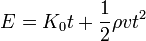
- All kinematics equations
Most kinematics equations are polynomials, usually at most quadratic, and are often integral quantities (corresponding to the 1/2 t^2 term). This specific equation resembles the actual kinematics equation d = vt + 1/2at^2, but replaces a (acceleration) with v (velocity) times  (density) and replaces velocity with "K0", which is not a term used in kinematics.

- All number theory equations
Number theory is the study of the integers and their properties. Randall jokes about how this often involves the use of summations over integers. The subscripts are indices, but the use of π as a summation index is a joke — π is almost always used for the well-known constant 3.14159..., not a variable. The use of i as a summation variable is common, but the joke is that when it appears along with the constant e, as it does here it usually represents the imaginary unit √-1. As well, the constant e is out-of-place in a field like number theory — it's more closely related to fields like calculus/analysis. The use of the symbol  as a literal is also a joke.

- All fluid dynamics equations
Fluid dynamics equations often involve copious use of vector calculus operators. It's common in field theories like fluid dynamics and electromagnetism to represent equations of motion using multidimensional operators, like the  and closed contour integral ∮ which appear here. The fraction 8/23 is a comically weird choice, but various unexpected fractions do pop up in fluid dynamics. The ds and dt go with the double contour integral (s is probably distance, t is time), but the derivative with respect to at the end is very much a joke and not allowed.

- All quantum mechanics equations
Quantum mechanics often involves some of the foreign-looking symbols listed, including bra-ket notation, the tensor product, and the Greek letter Psi for a quantum state. Specifically, the left side of the equation is a ket state labeled Psi that depends on x and y (probably positions), while the right-hand side may be an operator A that depends on the state Psi (it is very unusual to have such a dependence) acting on what looks like another copy of that operator which depends on the outer product of states labeled by x and y (again strange). A charitable interpretation could be that the second A is the eigenfunction A of the operator A. Normally this is clearly indicated by giving the operator a “hat” (^ symbol) or making the eigenfunction into a ket eigenstate, but since the equation is intentionally nonsense both A’s are left ambiguous. Also note that the bra-ket math is inconsistent here, as the left side is a ket, but the right side is just two A’s, which are either operators or functions but are definitely not kets.

- All chemistry equations
Chemistry equations use formulas of chemical compounds to describe a chemical reaction. Such equations show the starting chemicals on the left side and the resulting products on the right side, as displayed. Sometimes such an equation might optionally indicate that an activation energy is required, for the reaction to take place in a sensible timeframe, e.g. by heating. A reaction requiring heating is usually indicated by a Greek capital letter Delta (Δ) or a specified temperature above the reaction arrow, however this comic uses the "+ HEAT" term on the left side instead. The joke is that Randall interprets "HEAT" to be another chemical which reacts with Hydrogen (H) to H2EAT, which is nonsensical, as heat is transferred energy here, not added matter. Regardless of this, Randall gets the stoichiometry of this equation correct, with the same number of all types of 'atoms' on each side of the equation.

- All quantum gravity equations
Quantum gravity uses mathematical groups denoted by uppercase letters, as shown. SU(2), U(1), and U(2) are all well-studied groups, though 'SU(U(2))' makes no sense. The lack of relator means this expression isn't an equation, but an expression.


