what if? (blog)
- For other instances of this title, see What If (disambiguation).

|
This is one of 53 incomplete explanations:
|

what if? is a blog hosted on the xkcd.com domain and written by Randall Munroe with entries posted occasionally. On the blog, Randall Munroe discusses hypothetical physics questions submitted by readers. Before publishing the What If? book, articles were usually posted weekly. what if? typically takes questions beyond the original scope likely intended by the reader for humorous effect. The featured questions range from questionably realistic possibilities (e.g. the probability of achieving a perfect SAT score by guessing) to completely fictional questions (e.g. what happens if you create a billion-story building)). In his explanations, Randall, often uses diagrams in an xkcd style. Regardless of the context, he tends to take the questions extremely literally and responds seriously to them, however whimsical they are. This site is not under Creative Commons Attribution-NonCommercial 2.5 License, unlike normal xkcd comics. Most illustrations present on the blog have individual title texts, similar to almost all xkcd comics. Initially, these title texts were just visual descriptions of the illustrations, but later explanations had title texts that added a bit of humor into the blog articles, more in line with their use in the comics.
In 2014, Randall released the first What If? book, which was made up of articles that had already been released on the blog, as well as new, exclusive chapters. The same formula would later be used in 2022, with the release of the second book, What If? 2. In 2024, Randall published What If? 10th Anniversary Edition, a revised and updated version of the original containing one bonus chapter.
On August 31 2023, after the first two what if? books had been published, Randall created the official what if? YouTube channel, called xkcd's What If?, and is produced by Neptune Studios LLC. In the channel, he voice-overs his previously published articles and adds novel corrections and illustrations.
A similar series of articles written and illustrated in the what if? style by Randall Munroe can be found in the New York Times' Good Question column
History[edit]
The creation of the what if? blog was announced in a header text on xkcd.com, and the first few articles were also promoted thru other changes to header text. The first two articles, 1: Relativistic Baseball and 2: SAT Guessing, were released simultaneously on July 10, 2012, likely to establish the blog and attract readers from xkcd. Following this, new articles were published weekly for nearly three years, with only occasional gaps of two or three weeks. This consistent schedule continued until article 136: Spiders vs. the Sun was released on April 12, 2015, marking two years and forty weeks of regular updates.
Release schedule[edit]
Initially, articles were published on Tuesdays, with the third article appearing on July 17, 2012. This changed to Wednesdays with article 100: WWII Films, released on June 11, 2014, and then to Thursdays with article 117: Distant Death on October 23, 2014. The final six articles of this period were released on four different weekdays, with only two appearing exactly one week apart.
After 25 articles, the first deviation from the weekly schedule occurred with a two-week Christmas break before article 26 was published on December 31, 2012. Over the following years, five additional two-week breaks, a single three-week break (before December 11, 2014), and a brief period where two articles, 133: Flagpole and 134: Space Burial, were released in quick succession led to minor fluctuations in the schedule. Another Christmas break occurred before article 77: Growth Rate was released on December 31, 2013. From August 2014 onward, more frequent two-week breaks appeared, including one in August, one in September, and two in November, culminating in the usual Christmas hiatus.
Following article 136: Spiders vs. the Sun, published on April 12, 2015, Randall took a 13-week break, returning on July 14, 2015. At the time, he announced, "What If updates are temporarily on hold, and will resume on July 14th, 2015, at 7:49:59 AM EDT." This timing coincided with the New Horizons probe’s closest approach to Pluto, which was also the topic of article 137: New Horizons, released that same day.
After this break, only three more articles appeared in 2015, with the last, article 139: Jupiter Descending, published on August 4. Another extended pause followed, with just one more release that year—article 140: Proton Earth, Electron Moon on September 18, 2015, after a six-week gap. Regular releases resumed in 2016 with article 141: Sunbeam on January 16, followed by nine more publications before the end of March, initially on Tuesdays, then shifting to Fridays and Saturdays. Article 149: Pizza Bird, released on March 26, 2016, was the last to appear before another slowdown.
Only three more articles were published in 2016, with gaps of roughly eight and twelve weeks between them. During the summer, the release frequency dropped to approximately one article every two months.
Peptides incident[edit]
The final article of the year, 153: Peptides, was published on December 5, 2016. However, it was removed the following day and replaced with a notice explaining it was just an early draft:
- Whoops
- This article is still in progress. An early draft was unintentionally posted here thanks to Randall's troubled approach to git, and it took a little bit to get everything sorted out and rolled back. Sorry for the mixup!
On Thursday, 15 September 2022, user ibid11962 personally asked Randall Munroe about the incident at the What If? 2 book tour at the Strand Bookstore in New York. Randall said that he knew which article he was referring to, but didn't remember any of the circumstances of it being released and then unreleased. He recorded the conversation and sent the recording of Randall's answer to User:FaviFake on Discord, along with a transcript. The transcript reads:
ibid11962: Six years ago you made a what-if called "Peptides" and then took it down the day later and said that it would be up soon. It still hasn't ever appeared. I'm wondering why is that and are there any plans to use it?Randall Munroe: I am going to have to go and look and see why. I don't remember off-hand.
ibid11962: It was a what-if about making words with amino acids.
Randall Munroe: Hmm. Oh yeah, yeah, yeah. I think that I just had posted it by mistake. It was a draft that I was working on. And I don't know. I must have decided I didn't like the draft the way it turned out. I'm gonna have to go back through though, because I had forgotten about that until you brought it up just now. So I'll take a look. ... Yeah, I occasionally find something that I like got halfway through and then set aside for some reason and forgot about.
However, a completed version of this article was never published, and the URL was later reassigned to article 153: Hide the Atmosphere.
Sporadic releases[edit]
The first article of 2017, article 153: Hide the Atmosphere, was released on January 30, nearly 15 weeks after the previous entry, making it the second-longest hiatus at the time. However, subsequent articles, including articles 154: Coast-to-Coast Coasting and 155: Toaster vs. Freezer, were released more frequently, appearing within a few weeks of each other. This marked a brief resurgence in activity, though the overall publication rate remained low—only eight articles were released between February 2016 and February 2017.
Following article 156: Electrofishing for Whales, released in March 2017, updates ceased entirely for over a year. It was not until May 2018, 62 weeks later, that article 157: Earth-Moon Fire Pole, was published. This marked the beginning of a nearly four-year absence of new content on the blog. The extended hiatus was likely due to Randall's work on the What If? 2 book, as announced in 2575: What If? 2. However, in the lead-up to the book’s release, the blog saw a brief return of activity:
- Article 158: Hot Banana, was published almost four years after the last update.
- Articles 159: Hailstones, 160: Transatlantic Car Rental, and 161: Star Ownership were each released about two months after the previous article.
- The most recent article, 162: Comet Ice, was released about a month later, on December 6, 2022.
Since 162: Comet Ice, no further articles have been published on the blog, marking a break of over three years.
There are many reasons Randall might have slowed down. Releasing too many articles may disincentivize people from buying the books, the YouTube page is better marketing, it is faster to upload videos than to write an elaborate blog,[actual citation needed] people aren't asking interesting questions, the increased popularity of the article has led to too many questions being asked and it becomes increasingly unfair to answer one over the other, or other more personal reasons that Randall may not want to share. During this time, Randall has likely focused on writing more book-exclusive chapters and producing content for the YouTube channel.
Redesign[edit]
In November 2023, after the first What if? video, the site was redesigned so that above every article, a black bar with white text read "the news" and below that, smaller text read: "The next What If? video, "What if we aimed the Hubble Telescope at Earth?" is up on YouTube now!" For every new video, it was updated. As of June 28th, 2026, it reads "The next What If? video, "What if everything was antimatter EXCEPT Earth?" is up on YouTube now!"
All articles[edit]
Browse articles
This is an index of all articles featured in Randall Munroe's what if? blog and book series, organized and explained. For each article, the original question and a summary of Randall's answer are provided. If an article is available on the blog, you can click the title to read it in full. You can use the columns to sort the table alphabetically, by release date on the blog or YouTube, or by chapter in the books. The thumbnail is only available for articles published on the blog. If the title of a blog article differs from the one in the book, the latter is provided in the "Books" column.
A much simpler list that doesn't include book-exclusive articles can be found in the archive section of the blog. Similar articles by Randall have also been published in the New York Times' Good Question column.
| Title and thumbnail | Reader's question | Summary of Randall's answer | Article available in... (double-click to sort) | |||
|---|---|---|---|---|---|---|
| Blog | Books | YouTube | YT Shorts | |||
| "What would happen if you tried to hit a baseball pitched at 90% the speed of light?"
—Ellen McManis
|
The ball would create plasma and reach home plate in about 70 nanoseconds. The result would be some kind of nuclear explosion, destroying everything about a mile from the field. A ruling of "hit by pitch" could be interpreted in this situation. |
1st blog article, on 2012‑07‑10 |
What If?, Chapter 2 |
5th video, on 2024‑02‑06: "What if you threw a baseball at nearly light speed?" | 14th short video, on 2025‑10‑28: "What if you tried to hit a baseball pitched at 90% the speed of light?" | |
| "What if everyone who took the SAT guessed on every multiple-choice question? How many perfect scores would there be?"
—Rob Balder
|
No one would get a perfect score. The odds of guessing correctly on every question would be less than the odds of every living ex-president at that time and the main cast of Firefly getting struck by lightning on the same day. To put this as a number, the odds of this happening would be less than 1/10^100 (one googol). |
2nd blog article, on 2012‑07‑10 |
What If?, Chapter 66 |
|||
| "How much Force power can Yoda output?"
—Ryan Finnie
|
Yoda can output about 19.2 kilowatts, or 25 horsepower. "Yoda power" would cost about $2/hour. |
3rd blog article, on 2012‑07‑17 |
What If?, Chapter 32 |
|||
| "What would happen if you were to gather a mole (unit of measurement) of moles (the small furry critter) in one place?"
—Sean Rice
|
In physics, a mole is a number that equals approximately 6.022 × 10²³. If this amount of moles (the furry animals) were put in space, they would form a sphere a little bit larger than our Moon with about the same gravity as Pluto. The surface would freeze and trap the interior warmth, causing geysers of hot meat and methane. |
4th blog article, on 2012‑07‑24 |
What If?, Chapter 10 |
29th video, on 2025‑08‑19: "What if you had a mole of moles?" | ||
| "What if there was a robot apocalypse? How long would humanity last?"
—Rob Lombino
|
Humanity would most likely survive. Most robots can easily be subdued because technology hasn't been developed enough to allow them to walk, evade being destroyed, and kill us efficiently. They could decide to use our nuclear weapons, but that would hurt them more than us. |
5th blog article, on 2012‑07‑31 |
||||
| "What if a glass of water was, all of a sudden, literally half empty?"
—Vittorio Iacovella
|
If the vacuum were on the bottom half, it would explode, but if it were on the top half, the air rushes in and it becomes normal water. |
6th blog article, on 2012‑08‑07 |
What If?, Chapter 26 |
16th video, on 2024‑09‑24: "What if a glass of water were LITERALLY half empty?" | ||
| "Is there enough energy to move the entire current human population off-planet?"
—Adam
|
No, at least not without starving to death quickly and leaving our pets, belongings, and everything else behind. The best way to do it is either with a space tether or to ride the shockwave of a nuclear bomb, but the former lacks a good material and the latter is literally riding the shockwave of a nuclear bomb. In any case, highly impractical. |
7th blog article, on 2012‑08‑14 |
What If?, Chapter 35 |
|||
| "What would happen if everyone on earth stood as close to each other as they could and jumped, everyone landing on the ground at the same instant?"
—Thomas Bennett (and many others)
|
Earth would be unaffected, but almost all humans would probably be wiped out, due to the congestion of everybody being in one place at once. Utilities and everything requiring human oversight would eventually fail because no one was maintaining them. If airports became functional, only the largest would be able to efficiently get everybody home. Only the people at the edges of the giant crowd would be able to escape, with the rest almost certainly dying due to suffocation. The Earth would then be a lawless wasteland, with a severely diminished population trying to restore humanity to its former glory. |
8th blog article, on 2012‑08‑21 |
What If?, Chapter 9 |
9th video, on 2024‑04‑16: "What if everyone jumped at once?" | 17th short video, on 2025‑11‑25: "What if everyone on Earth was in the same place and jumped at the same time?" | |
| "What if everyone actually had only one soul mate, a random person somewhere in the world?"
—Benjamin Staffin
|
Assuming the soul mate can exist at any time, there is a high chance that you would not find your soul mate. Around 100 billion humans have ever existed, but only 8 billion of those people are alive today. This means that there is an over 90% chance that your soul mate is long dead. This is made worse by the fact that people will also be born in the future, and your soul mate could live very far in the future.
Even if it is assumed that someone's soul mate must be alive while they are alive, there's still a very low chance of finding your soul mate due to the sheer amount of people in the world. Even if you find them, they may speak another language and be unable to understand you. Jobs would also be affected, with very social jobs such as waiters, cashiers, or traffic guards being highly sought-after. |
9th blog article, on 2012‑08‑28 |
What If?, Chapter 6 |
|||
| "What would the world be like if the land masses were spread out the same way as now - only rotated by an angle of 90 degrees?"
—Socke
|
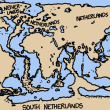
Hard to tell with any sort of certainty, but North America remains the same (just flipped, so Canada is tropical), South America becomes more like Europe before this question, Asia is flipped just like North America was, Europe becomes more like southeast Asia, Africa's climate is essentially rotated 90 degrees and East Africa gets a lot more tornadoes, Australia is colder and wetter, and Antarctica becomes a tropical rainforest. Of course, the biosphere collapses due to the shuffling and the ice caps (prematurely) melt, while also making certain wildlife appear elsewhere than normal. |
10th blog article, on 2012‑09‑04 |
23rd video, on 2025‑04‑01: "What if the Earth rotated 90 degrees?" | 28th short video, on 2026‑04‑21: "What would happen in Minnesota if the world rotated by 90 degrees?" | ||
| 30th short video, on 2026‑05‑12: "What would your country be like if the land masses were rotated by 90°?" | ||||||
| 31st short video, on 2026‑05‑19: "What would the world's largest cities be like if the land masses were rotated by 90 degrees?" | ||||||
| "If you went outside and lay down on your back with your mouth open, how long would you have to wait until a bird pooped in it?"
—Adrienne Olson
|
Assuming an even distribution of all birds across the Earth's surface and a frequency of 1 poop per hour, it would take you about 195 years on average. However, those assumptions are unrealistic: It would probably be closer to a few hours if you were laying under an area where large amounts of birds are common, such as a power line or tree. |
11th blog article, on 2012‑09‑11 |
||||
| "What if a rainstorm dropped all of its water in a single giant drop?"
—Michael McNeill
|
The surrounding area would be obliterated via the violent rush of crushing water, causing flash flooding in the surrounding area. There would be mass confusion for many following years. |
12th blog article, on 2012‑09‑18 |
What If?, Chapter 65 |
|||
| "If every person on Earth aimed a laser pointer at the Moon at the same time, would it change color?"
—Peter Lipowicz
|
It would take lots of power, but yes, assuming you want to drain the Earth's oil and cover Asia in megawatt lasers. Going even further in power level fries the Earth and launches the Moon into the solar system. |
13th blog article, on 2012‑09‑25 |
What If?, Chapter 7 |
18th video, on 2024‑11‑05: "What if everyone pointed a laser at the moon?" | ||
| "How long would the Sun last if a giant water hose were focused upon it?"
—Austin Dickey
|
The Sun would actually burn brighter due to water being mostly hydrogen (main fusion fuel of stars) and eventually become a black hole with all the mass of the water. |
14th blog article, on 2012‑10‑02 |
||||
| "What if you shined a flashlight (or a laser) into a sphere made of one-way mirror glass?"
—Chase Montgomery
|
One-way glass does not exist. The light shines through just like normal glass. The glass used for "one-way mirror glass" is semi-transparent and semi-reflective so that if it's used as a window between a brightly lit room and a dimly lit room, the reflection or transmission from the bright room will overwhelm the transmission or reflection from the dim room so that people looking at the glass from either side will see the bright room. | |||||
| "If Michael Phelps could hold his breath indefinitely, how long would it take for him to reach the lowest point in the ocean and back if he swam straight down and then straight back up?"
—Jimmy Morey
|
Michael Phelps would die somewhere between 100 and 400 meters of depth. If he were immune to pressure, then it would take 3 hours to swim to the bottom of the Marianas Trench and back. | |||||
| "In the first Superman movie, Superman flies around Earth so fast that it begins turning in the opposite direction. This somehow turns back time [... ] How much energy would someone flying around the Earth have to exert in order to reverse the Earth's rotation?"
—Aidan Blake
|
Superman wasn't pushing the Earth. He was flying superluminally and was thus travelling back through time. | |||||
| "How fast would you have to go in your car to run a red light claiming that it appeared green to you due to the Doppler Effect?"
—Yitzi Turniansky
|
The Doppler Effect is when waves (such as light or sound) change based on movement or position. You would need to go about one sixth of the speed of light. | |||||
| "What would happen if you opened a portal between Boston (sea level) and Mexico City (elev. 8000+ feet)?"
—Jake G.
|
There would be winds of 440 mph (708 km/h) sucking Boston into Mexico City. | |||||
| "When my wife and I started dating she invited me over for dinner at one time. Her kitchen had something called Bauhaus chairs, which are full of holes, approx 5-6 millimeters in diameter in both back and seat. During this lovely dinner I was forced to liberate a small portion of wind and was relieved that I managed to do so very discretely. Only to find that the chair I sat on converted the successful silence into a perfect, and loud, flute note. We were both (luckily) amazed and surprised and I have often wondered what the odds are for something like that happening. We kept the chairs for five years but despite laborious attempts it couldn't be reproduced."
—R. D.
|
This... isn't actually a question, but thank you for sharing! | |||||
| "What if you exploded a nuclear bomb (say, the Tsar Bomba) at the bottom of the Marianas Trench?"
—Evin Sellin
|
Surprisingly, not much! Large waves already disappear quickly when created by surface explosions, and moving the detonation underwater only lessens the effect. If you exploded a Tsar Bomba at the bottom of the Mariana Trench, the resulting eruption would create massive bubbles before turning into warm water and debris. |
15th blog article, on 2012‑10‑09 |
||||
| "How dangerous is it to be in a pool during a thunderstorm?"
—Jay Gengelbach
|
Pretty dangerous, as if the pool was hit, 20,000 amps of electricity from the lightning bolt would spread across the surface and shock you. Randall recommends that one should stay at least 12 meters away from a pool during a thunderstorm. |
16th blog article, on 2012‑10‑16 |
What If?, with a different title, Chapter 19: Lightning |
|||
| "What would happen if you were taking a shower or standing under a waterfall when you were struck by lightning?"
—Same3Chords
|
The droplets of water wouldn't be dangerous, but a tub of water or any puddle you stand in will be dangerous. | |||||
| "What would happen if you were in a boat, plane or a submarine that got hit by lightning?"
—Soobnauce
|
A boat would be as safe as a car if it had a cabin and lightning protection, while a submarine would be completely safe. The plane was not mentioned. | |||||
| "What if you were changing the light at the top of a radio tower and lightning struck? Or what if you were doing a backflip? Or standing in a graphite field? Or looking straight up at the bolt?"
—Danny Wedul
|
You would get shocked normally if you were on a radio tower, doing a backflip, or looking straight up (which would also damage your eyes). These all don't matter much. Randall doesn't know what a graphite field is and chose not to answer that part of the question. | |||||
| "What would happen if lightning struck a bullet in midair?"
—Timothy Campbell
|
The bullet might be heated a little bit, but it's travelling too fast to have any impact. | |||||
| "What if you were flashing your BIOS during a thunderstorm and you got hit by lightning?"
—NJSG
|
It would bring you to “Microsoft BOB®”, “Gateway 2000 Edition”. | |||||
| "If cows could photosynthesize, how much less food would they need?"
—Anonymous
|
They would need 4% less food. There simply isn't enough area on the cow for photosynthesis to provide all its energy requirements. |
17th blog article, on 2012‑10‑23 |
||||
| "In Armageddon, a NASA guy comments that a plan to shoot a laser at the asteroid is like “shooting a b.b. gun at a freight train.” What would it take to stop an out-of-control freight train using only b.b. guns?"
—Charles James O'Keefe
|
This would normally be impossible. However, with enough people shooting the train, it can happen. This would require about 100,000 people shooting, distributed over 2 kilometers of track, each firing a few dozen rounds once the train comes close enough. This would, eventually, be enough to bring the train to a stop. |
18th blog article, on 2012‑10‑30 |
||||
| "What if there's LITERALLY a tie?"
—Nate Silver (Twitter, January 4th, 2012)
|
In the case of each candidate getting the exact same amount of votes on Election Day, most states would randomly pick one, whether it be through tossing a coin, drawing a name or straws. The chances of this happening in 9 battleground states would be about equal to the elector drawing a name from a hat, then being smashed by a bale of cocaine by drug smugglers and obliterated by a meteorite impact while being swept away in a tornado. |
19th blog article, on 2012‑11‑06 |
||||
| "If a meteor made out of diamond and 100 feet in diameter was traveling at the speed of light and hit the earth, what would happen to it?"
—Aidan Smith, Age 8, via his father Jeff
|
Nothing made of matter can travel at the speed of light, but at the closest speed observed (99.99999999999999999999951% of the speed of light, the speed of the Oh-My-God particle), the Earth would explode with enough force to impact the entire inner Solar System. |
20th blog article, on 2012‑11‑13 |
||||
| "Is it possible to build a jetpack using downward firing machine guns?"
—Rob B
|
You'd need a Russian 30 mm rotary cannon to do it optimally, and the excessive force would definitely hurt you. If you braced the rider, created an aerodynamic craft strong enough to survive the acceleration, and cooled the craft, you'd be able to jump mountains. |
21st blog article, on 2012‑11‑20 |
What If?, with a different title, Chapter 14: Machine-Gun Jetpack |
36th video, on 2026‑02‑10: "What if you made a jetpack using rifles?" | ||
| "If you carry a penny in your coin tray, how long would it take for that penny to cost you more than a cent in extra gas?"
—Leto Atreides
|
140,000 miles if gas was the only cost involved. The exercise of picking up the penny can prolong your lifespan, but you've wasted valuable seconds reading this article. |
22nd blog article, on 2012‑11‑27 |
||||
| "If my printer could literally print out money, would it have that big an effect on the world?"
—Derek O'Brien
|
Using the printer, you could make about 200 million dollars per year, depending on the type of printer. This would actually be the perfect sweet spot for you, as it would be enough to make you very, very rich, but not enough to have any effect on the world. The United States prints approximately $160 billion per year, so $200 million a year would be nothing more than a drop in the bucket. |
23rd blog article, on 2012‑12‑04 |
What If?, with a different title, Chapter 18: Short-Answer Section |
|||
| "What would happen if you exploded a nuclear bomb in the eye of a hurricane? Would the storm cell be immediately vaporized?"
—Rupert Bainbridge (and hundreds of others)
|
No. Dr. Christopher Landsea of the National Oceanic and Atmospheric Administration has published a response explaining why it wouldn't work. | |||||
| "If everyone put little turbine generators on the downspouts of their houses and businesses, how much power would we generate? Would we ever generate enough power to offset the cost of the generators?"
—Damien
|
If it's very rainy, it would generate 800 watts of power, which isn't enough to offset the cost of the generators. | |||||
| "Using only pronounceable letter combinations, how long would names have to be to give each star in the universe a unique one word name?"
—Seamus Johnson
|
About 24 characters. | |||||
| "I bike to class sometimes. It's annoying biking in the wintertime, because it's so cold. How fast would I have to bike for my skin to warm up the way a spacecraft heats up during reentry?"
—David Nai
|
You'd have to bike at about 200 m/s, which would make your commute very fast indeed. However, the amount of energy required to bike at that speed would cause you to die from overexertion. This might work if you didn't exert any energy, however. | |||||
| "How much physical space does the internet take up?"
—Max L
|
Using humanity's total produced storage space from the last few years as an upper bound, and assuming 3.5" drives, the Internet is less than the size of an oil tank. | |||||
| "What if you strapped C4 to a boomerang? Could this be an effective weapon, or would it be as stupid as it sounds?"
—Chad Macziewski
|
Strapping C4 to a boomerang does not sound like an effective weapon. The weapon as depicted in the image would have terrible aerodynamics, and would not fly an easily predictable trajectory. C4 is, by itself, an inert substance which would need some form of detonator to actually explode, in which case it would depend upon how you set it up (e.g. timer or inertial trigger) and at what point in its flight this would activate. If this happened as it returns (or flies past, if thrown reasonably correctly but being unable or unwilling to catch it), it might kill or injure the thrower and/or those nearby. There were many unstated details as to how the proposal would be implemented, as Randall lampshades in his open answer. | |||||
| "How many model rocket engines would it take to launch a real rocket into space?"
—Greg Schock, PA
|
It would take about 65,000, but they'd have to be layered in a cone shape with about 30 stages so the vehicle has thrust for long enough. It could carry 60 kg, much of that spent on all the parts of the rocket that aren't the engine. And this contraption would not attain orbital velocity, but rapidly fall back to Earth after briefly leaving the atmosphere. Accelerating to orbital velocity is a whole other class of problem and cannot be achieved using model rocket engines in any practical way. |
24th blog article, on 2012‑12‑11 |
||||
| "The story of the three wise men got me wondering: What if you did walk towards a star at a fixed speed? What path would you trace on the Earth? Does it converge to a fixed cycle?"
—N. Murdoch
|
No, but the paths they would take would make some really cool patterns due to various factors, such as the Earth's rotation and its position changing in its orbit around the Sun. |
25th blog article, on 2012‑12‑18 |
22nd video, on 2025‑03‑04: "What if the wise men kept walking after Jesus's birth?" | 24th short video, on 2026‑03‑10: "Where would the three wise men go if they followed a planet?" | ||
| 25th short video, on 2026‑03‑17: "Which path would the three wise men have walked?" | ||||||
| "Every now and then we have to insert a leap second because the Earth's rotation is slowing down. Could we speed up Earth's rotation, so that we do not need Leap Seconds?"
—Anton (Berlin, Germany)
|
The only real way to do this is by hitting Earth with asteroids; all other ideas would be too difficult or wouldn't work. With 50,000 planets B-612 hitting the Earth each second and a few assumptions, we could stop worrying about leap seconds (mostly because it would deliver the energy of about one dinosaur-killer asteroid every couple days, wiping out life on Earth quite quickly) |
26th blog article, on 2012‑12‑31 |
||||
| "If one randomly chosen extra person were to die each second somewhere on Earth, what impact would it have on the world population?"
—Guy Petzall
|
The world population would continue to grow, though 40% more slowly. Pilots, drivers, and surgeons would die en route and mid-operation, but these would be comparable to usual accident rates and handled fairly easily.
In the article, Randall used a total of six "[citation needed]" tags and similar tags, all in the last sentence. |
27th blog article, on 2013‑01‑08 |
||||
| "From what height would you need to drop a steak for it to be cooked when it hit the ground?"
—Alex Lahey
|
From the very edge of the atmosphere, but even in that case it might not be fully cooked, as the steak will have to pass through parts of the atmosphere that are freezing cold and the parts of the fall where heat is being applied are more likely to char and disintegrate the steak than cook it. |
28th blog article, on 2013‑01‑15 |
What If?, Chapter 23 |
|||
| "What if I took a swim in a typical spent nuclear fuel pool? Would I need to dive to actually experience a fatal amount of radiation? How long could I stay safely at the surface?"
—Jonathan Bastien-Filiatrault
|
As long as you don't touch strange things and you don't swim too close to the fuel rods, it would be just like a regular pool. Except for the fact you would never make it to the pool, as the guards would notice and shoot you to death. |
29th blog article, on 2013‑01‑22 |
What If?, Chapter 3 |
8th video, on 2024‑04‑02: "What if you swam in a nuclear storage pool?" | 16th short video, on 2025‑11‑18: "Could you swim in a spent nuclear fuel pool?" | |
| "What would happen if you tried to fly a normal Earth airplane above different Solar System bodies?"
—Glen Chiacchieri
|
Most of the Solar System bodies lack atmospheres and thus cannot be flown over. An airplane close enough to the sun to try to fly in its atmosphere would be instantaneously vaporized. It would be difficult to fly on Mars because the atmosphere is thin enough that a plane like the hypothetical Cessna must travel at Mach 1 to stay aloft, which would make the momentum too high for such a plane to steer properly, so you would crash. Jupiter's gravity is too strong, so the plane would sink into the atmosphere, tumbling in the high winds, until the increasing pressure crushed it. The remaining gas giants have weaker gravity, but still have nowhere to land, so you would eventually freeze, tumble and be crushed. Titan and Venus are the best bets, but Titan is cold, so the pilot would freeze to death, and Venus is full of sulfuric acid, which would cause the plane to burn up. |
30th blog article, on 2013‑01‑29 |
What If?, Chapter 30 |
|||
| "When - if ever - will the bandwidth of the Internet surpass that of FedEx?"
—Johan Öbrink
|
Probably never, unless the Internet's transfer rate grows faster than storage rates, the Internet won't surpass an army of FedEx trucks. However, the ping times would be absurd. |
31st blog article, on 2013‑02‑05 |
What If?, Chapter 44 |
|||
| "If the Hubble telescope were aimed at the Earth, how detailed would the images be?"
—Kyle Rankin
|
Very blurry because Hubble isn't able to rotate fast enough to track the surface of the Earth. Hubble is the wrong tool for the job, you're thinking of a spy satellite. |
32nd blog article, on 2013‑02‑12 |
1st video, on 2023‑11‑29: "What if we aimed the Hubble Telescope at Earth?" | 10th short video, on 2025‑09‑16: "Could the Hubble take a photo of you?" | ||
| 11th short video, on 2025‑09‑23: "How detailed would the Hubbles images be if it looked at Earth?" | ||||||
| "How much would the sea level fall if every ship were removed all at once from the Earth's waters?"
—Michael Toje
|
The sea level would fall by about 6 microns, slightly more than the diameter of a strand of spider silk. However, since the oceans are currently rising at about 3.3 millimeters per year due to global warming, the water would be back up to its original average level in 16 hours. |
33rd blog article, on 2013‑02‑19 |
||||
| "How many unique English tweets are possible? How long would it take for the population of the world to read them all out loud?"
—Eric H., Hopatcong, NJ
|
Since there are 2 * 1046 meaningful English tweets based on the original character limit of 140 and written English having an average information content of 1.1 bits per character, reading them all would take 10,000 "eternal years", with an eternal day being the length of time needed to wear down a 100-mile mountain if a bird scraped 1 grain every thousand years. |
34th blog article, on 2013‑02‑26 |
What If?, Chapter 50 |
|||
| "What would happen if a hair dryer with continuous power was turned on and put in an airtight 1x1x1 meter box?"
—Nathan Terrell
|
The box would heat up to about 60°C. This is hot enough to burn out a normal hair dryer. For an indestructible hair dryer, incrementing the power would heat it further until the containing box melted, which would happen by the 187 MW mark for most materials. If both the hair dryer and the box were indestructible, incrementing the power would heat it further until the ground starts melting, and around the 20 GW mark, it would eventually create updrafts and bounce around everywhere. Turning it off and on again (to 11 PW) would launch it out of the sky in glowing fury. |
35th blog article, on 2013‑03‑05 |
What If?, Chapter 11 |
|||
| "How much cornstarch can I rinse down the drain before unpleasant things start to happen?"
—Anna R., Fort Wayne, IN
|
It depends what you consider unpleasant. Your sink will clog and your house will flood with oobleck, but if you really really like cornstarch then nothing unpleasant will happen. |
36th blog article, on 2013‑03‑12 |
||||
| "What if you somehow managed to make a stereo travel at twice the speed of sound, would it sound backwards to someone who was just casually sitting somewhere as it flies by?"
—Tim Currie
|
Assuming the stereo is indestructible, yes. Although with a ballistic launch, you'd only get it supersonic for less than a second, it would spend just a few seconds within hearing range, and the backwards music you'd hear would be mixed with music sounding at half speed as the stereo departs. |
37th blog article, on 2013‑03‑19 |
||||
| "With today's technology, would it be possible to launch an unmanned mission to retrieve Voyager I?"
—Elliot Bennett
|
You could reach Voyager I with some well-timed gravity assists from Jupiter and Saturn, but getting back would require an absurd amount of fuel. You could use ion fields to require less fuel, but they also produce less thrust. |
38th blog article, on 2013‑03‑26 |
||||
| "How hard would a puck have to be shot to be able to knock the goalie himself backwards into the net?"
—Tom
|
This can't really happen, due to the size and weight difference between the goalie and a hockey puck. You'd need to fire an object at Mach 8 to knock the goalie back, but firing a puck at that speed would char the puck while air resistance would slow it down. If a hockey puck actually reached the goalie at such a high speed, it would have a similar effect to hitting a cake with a tomato as hard as you can. |
39th blog article, on 2013‑04‑02 |
What If?, Chapter 24 |
|||
| "Am I right to be afraid of pressure cookers? What's the worst thing that can happen if you misuse a pressure cooker in an ordinary kitchen?"
—Delphine Lourtau
|
Ordinarily, the worst that can happen is the lid blowing off and superheated liquid spraying everywhere, but you can use one to make Dioxygen difluoride, which is much worse. |
40th blog article, on 2013‑04‑09 |
||||
| "If everybody in the US drove west, could we temporarily halt continental drift?"
—Derek
|
No. While technically the car fleet could reverse the momentum of the North American plate, the continental drift is being powered by the forces in the Earth's mantle, and these forces outmatch the car fleet by millions of times. |
41st blog article, on 2013‑04‑16 |
||||
| "What is the longest possible sunset you can experience while driving, assuming we are obeying the speed limit and driving on paved roads?"
—Michael Berg
|
The longest way you can experience a sunset while driving is on certain roads in Norway and Finland around the winter solstice for 95 minutes, as this is where the best method to outpace the Sun works (outpacing the terminator).
The answer references comic 162: Angular Momentum and the video for the article includes a different, colored version of the original comic. |
42nd blog article, on 201304‑23‑ |
What If?, Chapter 52 |
32nd video, on 2025‑10‑21: "Can you drive west to lengthen the sunset?" | 40th short video, on 2026‑08‑18: "How long could you drive towards the sunset?" | |
| "Could a high-speed train run through a vertical loop, like a rollercoaster, with the passengers staying comfortable?"
—Gero Walter
|
Even if the requirements were changed to just the passengers surviving, this wouldn't be plausible. A train can't complete a full loop without the loop being too small, making the train move too fast and making every passenger die from the g-forces involved. |
43rd blog article, on 2013‑04‑30 |
||||
| "How high can a human throw something?"
—Irish Dave on the Isle of Man
|
Based on estimations and aerodynamics calculations, the holder of the record for fastest pitch (Aroldis Chapman) could probably throw up to 16 giraffes (80 m) high if he were using a golf ball. Unless you count letting go of balloons, of course. |
44th blog article, on 2013‑05‑07 |
What If?, Chapter 38 |
|||
| "Is this the most expensive music video ever?"
—Various Youtube commenters
|
No. If the construction cost of the setpiece is how this is measured, then it would be U2's "Last Night on Earth" on a section of Interstate Highway. If not, then it doesn't even come close to Thriller. |
45th blog article, on 2013‑05‑14 |
||||
| "I've been told that if the Earth were shrunk down to the size of a bowling ball, it would be smoother than said bowling ball. My question is, what would a bowling ball look like if it were blown up to the size of the Earth?"
—Seth C.
|
A bowling ball the size of the Earth would be much less dense, and have much less gravity. The surface bumps and ridges would be much smaller than those on Earth with a maximally rough ball having peaks of roughly 200 m. The finger holes, on the other hand, would be huge, about a thousand km across and several thousand km deep. Due to this, the finger holes would collapse. causing eruptions of hydrocarbons and scars similar to those on the Moon. |
46th blog article, on 2013‑05‑21 |
||||
| "Let's assume there's life on the the nearest habitable exoplanet and that they have technology comparable to ours. If they looked at our star right now, what would they see?"
—Chuck H.
|
They wouldn't be able to see us very well. Radio waves fade quickly in space and we've stopped sending out as many of them. If they happened to pick up, they would only get a message similar to the Wow! Signal. The best message they could see is visible light, as the water and weather on Earth's surface would be a telltale marker of some form of life. |
47th blog article, on 2013‑05‑28 |
What If?, Chapter 28 |
|||
| "When (if ever) did the Sun finally set on the British Empire?"
—Kurt Amundson
|
If the British Empire kept the borders it had when the question was written, it would continue to experience eternal sunshine for many thousands of years until a total eclipse hits the Pitcairn Islands at the right time.
However, in 2025, after the publication of this article, the UK signed a treaty to give the British Indian Ocean Territory to Mauritius. Once the treaty is ratified, and the territory is officially handed over, the Sun can finally set on the British Empire. |
48th blog article, on 2013‑06‑04 |
What If?, Chapter 60 |
|||
| "What would happen to the Earth if the Sun suddenly switched off?"
—Many, many readers
|
We would see a variety of benefits across our lives such as the elimination of time zones, more reliable satellites, easier astronomy, and safer wild parsnip, but the downside is we would all freeze and die. |
49th blog article, on 2013‑06‑11 |
What If?, Chapter 57 |
24th video, on 2025‑04‑15: "What if the sun suddenly went out?" | 26th short video, on 2026‑04‑02: "What would happen if the Sun went dark?" | |
| "What would it be like to navigate a rowboat through a lake of mercury? What about bromine? Liquid gallium? Liquid tungsten? Liquid nitrogen? Liquid helium?"
—Nicholas Aron
|
It would be difficult to row the boat on mercury because it's very dense. Bromine smells terrible and is highly toxic. Gallium would dissolve an aluminium boat. Liquid tungsten would incinerate you instantly. Liquid nitrogen would kill you either by suffocation or hypothermia. Liquid helium's superfluid properties would sink your boat, but at least you'd hear the “third sound” as you die. |
50th blog article, on 2013‑06‑18 |
||||
| "What place on Earth would allow you to freefall the longest by jumping off it? What about using a squirrel suit?"
—Dhash Shrivathsa
|
It takes 26 seconds to fall from the top of Mount Thor into a pit of cotton candy at the bottom of the cliff. The record for the longest wingsuit glide is 3 minutes and 20 seconds, from the Eiger – enough time for Joey Chestnut and Takeru Kobayashi to eat 45 hot dogs. |
51st blog article, on 2013‑06‑25 |
What If?, Chapter 45 |
|||
| "What if one were to drop 3,000 bouncy balls from a seven story parking structure onto a person walking on the sidewalk below? Should the person survive, what would be the number of bouncy balls needed to kill them? What injuries would occur and what would the associated crimes be?"
—Ginger Bread
|
If you dropped 3000 balls as stated, the balls would spread out like a cloud, and most of them would miss, with the remainder striking the target separately from one another. Around 3,000,000 balls would be enough to either crush a person or bury them too deep for them to get out. Death would occur and you would be charged with manslaughter or murder. |
52nd blog article, on 2013‑07‑02 |
||||
| "How quickly would the ocean's drain if a circular portal 10 meters in radius leading into space was created at the bottom of Challenger Deep, the deepest spot in the ocean? How would the Earth change as the water is being drained?"
—Ted M.
|
Hundreds of thousands of years, so you'll need a bigger portal. As their basins are cut off, many shallow seas and a few deep trenches remain, leaving much of Earth still covered with water. Massive, unpredictable environmental changes would probably wipe out mankind. If they didn't, the Dutch would take over the world, no longer preoccupied with preventing their lands from flooding as they are now. |
53rd blog article, on 2013‑07‑09 |
What If?, Chapter 48 |
12th video, on 2024‑06‑18: "What if you drained the oceans?" | 18th short video, on 2025‑12‑16: "What if you drained the oceans?" | |
| "Supposing you did Drain the Oceans, and dumped the water on top of the Curiosity rover, how would Mars change as the water accumulated?"
—Iain
|
The water would fill the Valles Marineris, eventually leaving only Olympus Mons and some other small islands. The sea would ultimately freeze over, become covered in dust, and migrate to permafrost at the poles. In the meantime, the Netherlands would colonize Mars through the portal. The video additionally mentions that the greenhouse gas effects caused by all the new water might keep Mars's oceans liquid. |
54th blog article, on 2013‑07‑16 |
What If?, Chapter 49 |
14th video, on 2024‑08‑13: "What if we teleported the oceans to Mars?" | 19th short video, on 2025‑12‑23: "What if we teleported the oceans to Mars?" | |
| "If you call a random phone number and say "God bless you", what are the chances that the person who answers just sneezed? On average, not just in spring or fall."
—Mimi
|
The chances they just sneezed are 1 in 40000. There's also a 1 in a billion chance that the person you called just murdered someone, a 1 in 10 trillion chance they've just been killed by lightning, and – if five people spend a day trying this by calling random people – another 1 in 10 trillion chance that you and the other person called each other simultaneously. |
55th blog article, on 2013‑07‑23 |
What If?, Chapter 53 |
|||
| "If you wanted to anchor an airplane into the ground so it wouldn't be able to take off, what would the rope have to be made out of?"
—Connor Childerhose
|
A steel cable an inch thick, the lines of an army of thousands of fishermen, or the hair of 20 people. Hair has the highest tensile strength of any material in your body. |
56th blog article, on 2013‑07‑30 |
||||
| "What if a huge mountain—Denali, say—had the bottom inch of its base disappear? What would happen from the impact of the mountain falling 1 inch? What about 1 foot? What if the mountain's base were raised to the present height of the summit, and then the whole thing were allowed to drop to the earth?"
—John-Clark Levin
|
An inch or a foot wouldn't do much, it would only feel like a 3.5 magnitude earthquake. Dropped from its own height, Denali would cause a magnitude 7 earthquake and crush coal to diamonds. Dropped from the edge of Earth's gravity well, that's just a large asteroid (roughly 10% of the energy of the Chicxulub impact that caused the Cretaceous-Paleogene extinction event) and it would cause firestorms and an impact winter. If you removed it from Earth's gravity well but still tried to "drop" it, it might crash into Mars instead. |
57th blog article, on 2013‑08‑06 |
||||
| "What if a spacecraft slowed down on re-entry to just a few miles per hour using rocket boosters like the Mars-sky-crane? Would it negate the need for a heat shield?"
—Brian
|
No, because you need to go 8 km/s to stay in orbit, and it would take impossible amounts of fuel to slow down. The Curiosity rover used a heat shield for most of its deceleration and then used the sky crane for finer maneuvering relatively close to the ground. |
58th blog article, on 2013‑08‑12 |
What If?, Chapter 43 |
|||
| "Is it possible for a spacecraft to control its reentry in such a way that it avoids the atmospheric compression and thus would not require the expensive (and relatively fragile) heat shield on the outside?"
—Christopher Mallow
|
||||||
| "Could a (small) rocket (with payload) be lifted to a high point in the atmosphere where it would only need a small rocket to get to escape velocity?"
—Kenny Van de Maele
|
||||||
| "If you had a printed version of the whole of (say, the English) Wikipedia, how many printers would you need in order to keep up with the changes made to the live version?"
—Susanne Könings
|
You'd need six printers, but if using an ink printer, costs would rack up to $500,000 a month, dwarfing paper and maintenance costs. You'd need to file away past versions in case they were reverted (restored), which would be a nightmare. |
59th blog article, on 2013‑08‑20 |
What If?, Chapter 58 |
13th video, on 2024‑07‑09: "What if you tried to print Wikipedia?" | 20th short video, on 2026‑01‑27: "What if you printed all of Wikipedia?" | |
| "If you could teleport to a random place of the surface of the Earth, what are the odds that you'll see signs of intelligent life?"
—Borislav Stanimirov
|
70% of the time you would end up in the ocean. Restricting yourself to land, you'd see farmlands or dirt roads about 20-25% of the time (6-7% overall). But if it's night, you can see satellites just by looking up. |
60th blog article, on 2013‑08‑27 |
||||
| "How fast can you hit a speed bump while driving and live?"
—Myrlin Barber
|
At highway speeds, you could wreck your tires and suspension. Around 150-300 mph, the aerodynamics of a typical sedan will cause it to flip and crash before even reaching the speed bump. At 90% the speed of light, you could face a billion-dollar speeding ticket. |
61st blog article, on 2013‑09‑03 |
What If?, Chapter 41 |
|||
| "What if I jumped out of an airplane with a couple of tanks of helium and one huge, un-inflated balloon? Then, while falling, I release the helium and fill the balloon. How long of a fall would I need in order for the balloon to slow me enough that I could land safely?"
—Colin Rowe
|
You would need either an air-filled balloon at least 10 to 20 meters across to slow your fall, or 10 helium tanks that are 250 cubic feet. You'd only have a few minutes though, and starting from a higher place will not help much due to your higher terminal velocity in the thin atmosphere. |
62nd blog article, on 2013‑09‑10 |
What If?, Chapter 34 |
|||
| "If all digital data were stored on punch cards, how big would Google's data warehouse be?"
—James Zetlin
|
Using electric consumption and datacenter spending as a measuring stick, Google probably has around 1-2 million servers, which equates to around 15 exabytes (or 15,000,000,000,000,000,000 bytes). Assuming a punch card holds 80 characters, all of that data comes out a pile of punch cards that could cover New England to a depth of 4.5 kilometers/2.8 miles, 3x deeper than the ice sheets that covered the region during the most recent ice age. |
63rd blog article, on 2013‑09‑17 |
||||
| "If you suddenly began rising steadily at one foot per second, how exactly would you die? Would you freeze or suffocate first? Or something else?"
—Rebecca B
|
A nudist would survive for five hours, then succumb to the cold. With a good coat, one would survive for seven, even plausibly eight, until reaching the low-oxygen death zone and suffocating. However, your corpse would outlast the Earth as it was swallowed by the Sun. |
64th blog article, on 2013‑09‑24 |
What If?, Chapter 15 |
37th video, on 2026‑03‑03: "What if you floated upwards 1 ft every second?" | 45th short video, on 2026‑10‑20: "What if you floated upwards 1ft per second?" | |
| "If our Twitter timelines (tweets by the people we follow) actually extended off the screen in both directions, how tall would they be?"
—Anonymous
|
It's difficult to pin down an "average" for Twitter timeline lengths, as it greatly depends on how many people you follow and whom. An estimate by Diego Basch and the Tweet rate as of 2013 suggests that if everyone followed everyone, the section timeline extending to the past would have 345 billion tweets and be 8,000,000 kilometers (5,000,000 miles) tall. Using extrapolation techniques similar to those used in the German tank problem, the future and past timelines combined would likely contain 690 billion tweets. |
65th blog article, on 2013‑10‑01 |
||||
| "If winds reached 500 mph, would it pick up a human?"
—Grey Flynn, age 7, Stoneham, MA
|
500 mph winds are more than fast enough to pick up a person and propel them through the air. The speed at which the wind starts being able to pick up and propel a person is around 120 mph. In fact, 500 mph winds are so fast that they only occur on Earth in extreme situations like the immediate vicinity of an erupting volcano or the aftermath of a major asteroid impact at which point wind speed would only be one of many dangers to human survival. |
66th blog article, on 2013‑10‑08 |
||||
| "How long would it take for people to notice their weight gain if the mean radius of the world expanded by 1cm every second? (Assuming the average composition of rock were maintained.)"
—Dennis O'Donnell
|
After a month, the gain would be measurable but within the normal variation of gravity. After a year, it would be more prominent at 5%. Humans could survive with difficulty for a decade, but even in specially-built environments, they would succumb within a century as air itself became toxic from atmospheric pressure. After a few centuries, the Moon would fall into the Roche limit and crumble into rings. |
67th blog article, on 2013‑10‑15 |
What If?, Chapter 55 |
17th video, on 2024‑10‑15: "What if Earth grew 1cm every second?" | 6th short video, on 2025‑08‑05: "Circumference pop quiz!" | |
| "If an asteroid was very small but supermassive, could you really live on it like the Little Prince?"
—Samantha Harper
|
Technically, yes. However, there would be major challenges. For one, gravity would be at full strength at your feet, but only 25% strength at your head, giving the illusion that you're being stretched. You would only need to be able to dunk a basketball to jump out of the gravity well, or you could alternatively sprint at 5 meters per second; if you don't make it to that point, you would enter a highly irregular orbit during which tidal forces would pull on your body in strange ways. |
68th blog article, on 2013‑10‑22 |
What If?, Chapter 22 |
|||
| "When, if ever, will Facebook contain more profiles of dead people than of living ones?"
—Emily Dunham
|
This depends on if Facebook stays popular or declines in popularity over time. In the former case, the dead would only outnumber the living well into the 2100s; while in the latter, this happens around 2060. Facebook can afford to keep all our data indefinitely, but there are ethical questions. |
69th blog article, on 2013‑10‑29 |
What If?, Chapter 59 |
|||
| "How big of a lawn would you have to have so that when you finished mowing you'd need to start over because the grass has grown?"
—Nick Nelson
|
A normal, standard-issue mower running for 10 hours straight could cut an area of 25,000 square meters, or 27,000 yards; the ideal frequency to cut your lawn is once every 10 days, which means that 0.25 km² of lawn can be maintained by 10 hours of mowing every day [or 0.6 km² by mowing it constantly]. Using a much faster mower commissioned by the magazine Top Gear that is used all day, every day, it could cut an adult male cougar's home range (which the Washington Department of Fish and Wildlife reports as 50-150 square miles or 130-390 square kilometers). |
70th blog article, on 2013‑11‑05 |
||||
| "I was absentmindedly stirring a cup of hot tea, when I got to thinking, "aren't I actually adding kinetic energy into this cup?" I know that stirring does help to cool down the tea, but what if I were to stir it faster? Would I be able to boil a cup of water by stirring?"
—Will Evans
|
No, not really. It would take at least 1 horsepower (a lot for a person stirring), and reducing the power would just make it cool faster. Stirring faster and faster would cause a vacuum to form and stirring to become ineffective (and the tea would splash out everywhere). |
71st blog article, on 2013‑11‑12 |
What If?, Chapter 61 |
|||
| "What is the furthest one human being has ever been from every other living person? Were they lonely?"
—Bryan J. McCarter
|
The most well-documented candidates are the six Apollo astronauts piloting the Command Module orbiting the Moon while their fellow astronauts descended on the surface, at most 3585 km away. Antarctic explorers and pre-colonialism Polynesian explorers have a shot, but there's no good evidence of specific people who beat the Apollo record. Astronauts Mike Collins and Al Worden said they were not at all lonely, the latter even enjoying his solitude. |
72nd blog article, on 2013‑11‑19 |
What If?, Chapter 63 |
|||
| "How close would you have to be to a supernova to get a lethal dose of neutrino radiation?"
—(Overheard in a physics department)
|
Neutrinos are subatomic particles that barely interact with the universe at all, so it's hard to imagine a scenario where they could harm you, even in a supernova. But at about 2.3 AU, or a little farther than Mars is from the Sun, even the neutrinos would be dense enough to kill you. On the other hand, if you were that close, you were probably inside the star that created the supernova, in which case Into the Sun would apply. |
73rd blog article, on 2013‑11‑26 |
What If?, Chapter 39 |
|||
| "How much of the Earth's currently-existing water has ever been turned into a soft drink at some point in its history?"
—Brian Roelofs
|
Humans have likely consumed 6.5 trillion liters or 1.7 trillion gallons of soda ever, based on estimates of population growth and popularity of soda. Assuming humanity has drunk 100 trillion liters (26 trillion gallons) of water, it is reasonable to conclude that only 0.0000005% of Earth's current water reservoir has been turned into a soft drink. However, considering how long water takes to cycle around and certain prehistoric life forms, the water in the average soda was likely once consumed by a dinosaur. |
74th blog article, on 2013‑12‑03 |
||||
| "I use one of those old phones where you type with numbers—for example, to type "Y", you press 9 three times. Some words have consecutive letters on the same number. When they do, you have to pause between letters, making those words annoying to type. What English word has the most consecutive letters on the same key?"
—Stewart Bishop
|
According to Randall, the English word with the most consecutive letters on the same key is "Nonmonogamous". This would require you to type the 6 key (MNO) 16 times without stopping, in order to type 'nonmono'. With every letter included, typing this word would require pressing the 2, 4, 7, and 8 keys once each, and the 6 key a nice, even 20 times. However, Randall is wrong. The actual word with most consecutive letters on the same key is 'nonmonomolecular'. In order to type 'nonmonomo', you need to hit the 6 key a full 20 times. However, typing the full word wouldn't add any more presses of the 6 key, so it takes the same amount of 6 to type the full word as nonmonogamous. |
75th blog article, on 2013‑12‑10 |
||||
| "At what point in human history were there too many (English) books to be able to read them all in one lifetime?"
—Gregory Willmot
|
About the 1500s, as the population of active English writers reached a few hundred, meaning you would never be able to catch up (using the average word count for a few famous authors as a baseline). You might not want to read them, anyways. |
76th blog article, on 2013‑12‑17 |
What If? 2, Chapter 10 |
|||
| "What height would humans reach if we kept growing through our whole development period (i.e. till late teens/early twenties) at the same pace as we do during our first month?"
—Maria
|
We would reach 10 to 12 meters at age 20, though the human body is not scalable to those heights, as our bone structure is too thin, while our hearts wouldn't be able to pump the blood around. |
77th blog article, on 2013‑12‑31 |
||||
| "If a T-rex were released in New York City, how many humans/day would it need to consume to get its needed calorie intake?"
—Tony Schmitz
|
Estimates vary, but the T-rex was estimated to need 40,000 calories per day. Ryan North of Dinosaur Comics tells us that the average 80 kg/175 pound human contains 110,000 calories. Therefore, a T-rex would need to eat someone every 2 days or so. On the other hand, a T-rex wouldn't necessarily have to use humans specifically as a food source and could instead eat 80 hamburgers a day. |
78th blog article, on 2014‑01‑07 |
What If? 2, with a different title, Chapter 7: T. Rex Calories |
|||
| "What if we were to dump all the tea in the world into the Great Lakes? How strong, compared to a regular cup of tea, would the lake tea be?"
—Alex Burman
|
An average cup of tea requires 2 grams of tea per 100 mL of water, and to make proper tea out of the Great Lakes, you would need 450 billion tons of tea for the Great Lakes' 22,600 cubic kilometers/5400 cubic miles of water. A total year's supply of tea is only 4.8 million tons, which would make tea about as strong as 2 drops in a bathtub. To make proper lake tea, you could use Wular Lake in Kashmir or Ullswater in UK's lake district, due to the volume of both being small enough for the tea to work. Heating those lakes to proper steeping temperature would likely be quite difficult, so Boiling Lake in Dominica or Frying Pan Lake in New Zealand could also be good candidates as they're already hot. |
79th blog article, on 2014‑01‑14 |
||||
| "What if every virus in the world were collected into one area? How much volume would they take up and what would they look like?"
—Dave
|
Human viruses would fill about ten oil drums. All viruses would form a wet heap the size of a small mountain, with a texture resembling pus or meat slurry. The viruses are likely to have a small angle of repose, so to avoid having the pile collapse and flood the surrounding area, all the viruses could instead be contained in 150 football stadiums. |
80th blog article, on 2014‑01‑21 |
||||
| "Is there any way to fire a gun so that the bullet flies through the air and can then be safely caught by hand? e.g. shooter is at sea level and catcher is up a mountain at the extreme range of the gun."
—Ed Hui, London
|
Yes, eventually the bullet would come to a maximum height, at which point you could grab the bullet before it fell down. You'd need to grip it firmly, because the bullet would still have its rotational momentum and might jump out of your hand. A larger bullet would require a larger height to catch it at, and even then, it would still be difficult to grab. Of course, this is illegal and can injure you or other people. |
81st blog article, on 2014‑01‑28 |
What If? 2, Chapter 12 |
|||
| "Astrophysicists are always saying things like "This mission to this comet is equivalent to throwing a baseball from New York and hitting a particular window in San Francisco." Are they really equivalent?"
—Tom Foster
|
The baseball thing is much harder. You'd have to hit it out of the atmosphere, and a baseball is too small to do that. Even if you could, it's still not a fair comparison because astrophysicists are allowed to refine their approach as they close in on the target, which you can't do with a thrown baseball. It turns out that the comet mission requires about the same level of precision as laser eye surgery. |
82nd blog article, on 2014‑02‑05 |
||||
| "If you made a beach using grains the proportionate size of the stars in the Milky Way, what would that beach look like?"
—Jeff Wartes
|
Although red giants aren't as common as Sun-like stars or red dwarfs, they would form a stretch of gravel that went on for miles due to their large relative volume. 99% of all stars would form a small patch of sand. |
83rd blog article, on 2014‑02‑11 |
What If? 2, Chapter 16 |
|||
| "Has humanity produced enough paint to cover the entire land area of the Earth?"
—Josh (Bolton, MA)
|
There isn't enough paint to go around. The total estimated amount of produced paint, a trillion litres, is only enough to paint as much as the land area of Russia. |
84th blog article, on 2014‑02‑18 |
What If? 2, Chapter 14 |
|||
| "Assuming that you have a spaceship in orbit around the Earth, could you propel your ship to speeds exceeding escape velocity by hitting golf balls in the other direction? If so, how many golf balls would be required to reach the Moon?"
—Dan (Kanata, Ontario)
|
A person theoretically could propel your ship using golf balls, but, assuming they are being fired at 226 mph (363 km/h), the fastest world record, the amount of golf balls needed for this would be around the size of Earth and wouldn't even get you to the Moon. (An ordinary golfer hitting the ball at 120 mph (50 km/h) would need a bag of golf balls bigger than the solar system that would collapse into a black hole and be even more unusable.) You'd need a potato cannon fueled by acetylene firing golf balls at 310 mph (500 km/h) which reduces the size of the golf mass to 150 miles (240 kilometers). This would be incredibly costly and firing them faster would essentially be the same as building a normal rocket. |
85th blog article, on 2014‑02‑25 |
||||
| "In terms of human-made objects, has Voyager 1 travelled the farthest distance? It's certainly the farthest from Earth we know about. But what about the edge of ultracentrifuges, or generator turbines that have been running for years, for example?"
—Matt Russell
|
There are a few different frames of reference you can look at, but in normal terms Mariner 10 has traveled much farther than Voyager 1. It's travelled a couple of light-days around the Sun, while the Voyager probes have only travelled a dozen light-hours. |
86th blog article, on 2014‑03‑04 |
||||
| "I've occasionally seen "radar enforced" on speed limit signs, and I can't help but ask: How intense would radio waves have to be to stop a car from going over the speed limit, and what would happen if this were attempted?"
—Joausc
|
Radio waves are generally very weak. You'd need the collective energy of trillions of cell phones just to levitate a snow flake. To stop a car, you'd need at least 2 trillion joules of radiation, which would vaporize the car and everything else around it. |
87th blog article, on 2014‑03‑11 |
||||
| "How much CO2 is contained in the world's stock of bottled fizzy drinks? How much soda would be needed to bring atmospheric CO2 back to preindustrial levels?"
—Brandon Seah
|
There are currently 400 parts of carbon dioxide per million. To bring it down to pre-Industrial levels, you'd need 450 quadrillion cans of soda, each being able to hold 2.2 grams of CO2. This would cover Earth's land 10 times over. |
88th blog article, on 2014‑03‑18 |
||||
| "How far would a tungsten countertop descend if I dropped it into the Sun?"
—Michael Leuchtenburg
|
Tungsten has the highest melting point of any element, but even tungsten would melt before it got too far. If you protected it with a heat shield, it would get destroyed all the same by the battering of the particles in the Sun's atmosphere. It could possibly penetrate the surface if it was larger, but as it stands, it wouldn't get past the outer layers. |
89th blog article, on 2014‑03‑25 |
||||
| "If all the seas were one sea,
What a great sea that would be! If all the trees were one tree, What a great tree that would be! If all the men were one man, What a great man that would be! If all the axes were one axe, What a great axe that would be! And if the great man took the great axe, And cut down the great tree, And let if fall into the great sea, What a great splish-splash that would be! ... How great would all of these things be?" —John Eifert (quoting a Mother Goose rhyme)
|
The seas would be a little bigger than the Pacific Ocean. Trees can't grow taller than about 130 meters naturally, and would physically crush itself if above a few kilometers tall. Ignoring these restraints, the tree would be about 75 km tall with trunk diameter of 2 km. Ignoring human size restraints, the person would be close to 3 km tall. The axe would be about 500 meters long and relatively the size of a flimsy hatchet. It may take a few weeks to chop down the tree and the impact would create a tsunami that probably wouldn't wipe out the human race, but would be likely the deadliest single disaster in our history. |
90th blog article, on 2014‑04‑03 |
||||
| "I just moved into a new apartment. It includes hot water but I have to pay the electric bill. So being a person on a budget ... what's the best way to use my free faucet to generate electricity?"
—David Axel Kurtz
|
A small hydroelectric dam in the bathtub would yield about $0.25 per month of electricity, but the best option would probably be to bottle and sell your tap water, yielding about $38 million per year at $1.50 per bottle. |
91st blog article, on 2014‑04‑08 |
||||
| "What would happen if the Earth's rotation were sped up until a day only lasted one second?"
—Dylan
|
Everything on Earth would die, but if it happened when the Moon crosses the plane of the Earth, then everything in the Solar System will die (whether there is a difference is debatable). |
92nd blog article, on 2014‑04‑15 |
What If? 2, Chapter 21 |
|||
| "At what speed would you have to drive for rain to shatter your windshield?"
—Daniel Butler
|
Water droplets in air are normally lighter than the air, so this wouldn't happen under normal circumstances. However, at supersonic speeds, the water droplet would jet away from the impact point on the windshield at Mach 18. It wouldn't shatter the windshield, but it would slowly batter it away. If you really want to have your windshield broken by precipitation, it would probably be easier to find a hailstorm and drive under it. |
93rd blog article, on 2014‑04‑22 |
||||
| "My daughter — age 4.5 — maintains she wants a billion-story building. It turns out not only is that hard to help her appreciate this size, I am not at all able to explain all of the other difficulties you'd have to overcome."
—Keira, via Steve Brodovicz, Media, PA
|
The tower would be far too big to support itself under its own weight. The tower would also extend past the Moon. The sheer amount of elevators needed would provide little to no room for actual usable space. Additionally, space junk would be a large problem, as there is a high probability that space junk would collide with the tower. |
94th blog article, on 2014‑04‑29 |
What If? 2, Chapter 22 |
21st video, on 2025‑02‑11: "What if you built a billion-story building?" | 22nd short video, on 2026‑02‑17: "What if we built a billion-story building?" | |
| 23rd short video, on 2026‑02‑24: "How many elevators would you need in a billion-story building?" | ||||||
| "What took more energy, the building of the Great Pyramid of Giza or the Apollo Mission? If we could convert the energy to build the Great Pyramid, would it be enough to send a rocket to the Moon and back?"
—Michael Marmol
|
The Apollo Program took about the same manpower as the building of the Great Pyramids, but physics wise, the Great Pyramid only contains 1012 joules of gravitational potential energy. A single Saturn V rocket's fuel has 20 times more energy. |
95th blog article, on 2014‑05‑06 |
||||
| "What if Au Bon Pain lost this lawsuit and had to pay the plaintiff $2 undecillion?"
—Kevin Underhill
|
The debt would be incredibly great, to the point that everything ever created by man does not have enough value to pay it off. For comparison, former solicitor general Ted Olson leaked that he charges $1600 per hour for his services. Even if every habitable planet in the Milky Way had a population of 8 billion Ted Olsons, and you hired all of them for a thousand generations, the cost would still be lower than if you lost. |
96th blog article, on 2014‑05‑14 |
What If? 2, Chapter 23 |
|||
| "What if you were to somehow ignite the pollen that floats around in the air in spring? Other than being a really bad idea, what effect would it have?"
—Jessica Thornburg
|
It would just warm up the air by a very tiny bit, but only because it's so thinly spread. Gathering all of it from a large enough region into one pile could equal a nuclear weapon. |
97th blog article, on 2014‑05‑20 |
||||
| "Could you get drunk from drinking a drunk person's blood?"
—Fiona Byrne
|
No, you can't. Alcohol in a drunk person's blood would be very diluted and by the time you drank the 14 glasses needed to get drunk, you would've vomited on the account of drinking blood. That aside, you could also get iron overload as well as various blood-borne diseases. |
98th blog article, on 2014‑05‑27 |
What If? 2, Chapter 42 |
|||
| "I was watching this video and was wondering: How many birds there would need to be for gravity to take over and force them into a gargantuan ball of birds?"
—Justin Basinger
|
Each bird is 85 grams, with a density of around 43 grams per square meter. Because of this, the air would be 25 times stronger than the starlings and the substance governing the collapse. The air would have to be bigger than the Earth to collapse the starlings and the starlings themselves would need to be bigger than the Solar System. They would then promptly turn into a star. |
99th blog article, on 2014‑06‑03 |
||||
| "Did WWII last longer than the total length of movies about WWII? For that matter, which war has the highest movie time:war time ratio?"
—Becky
|
Assuming the average run time of a WWII film was 95 minutes, the combined length was 300 days, meaning World War II was longer than the movies 7 times over. The two most likely candidates for highest movie:war ratio are the Indo-Pakistani war, which lasted 13 days and has 5 catalogued films about it, and the Anglo-Zanzibar war, which only lasted 38 minutes but lacked any films. In 2015, someone took Randall's advice and made Zanzibar, a short film (31 minutes) that takes the record. |
100th blog article, on 2014‑06‑11 |
||||
| "As plastic is made from oil and oil is made from dead dinosaurs, how much actual real dinosaur is there in a plastic dinosaur?"
—Steve Lydford
|
Contrary to the name, oil is not made of dead dinosaurs, mostly being composed of marine plankton and algae. Geology is complicated, but the gist is that only a small fraction of a plastic dinosaur toy could've come from dinosaur oil, and depending on the location, it may contain none at all. |
101st blog article, on 2014‑06‑18 |
What If? 2, Chapter 26 |
|||
| "As a writer, I'm wondering what would be the cumulative energy of the hundreds of thousands of keystrokes required to write a novel."
—Nicholas Dickner
|
Writing one full novel would provide enough energy to run a laptop for 15 seconds. If each novel takes you six months, this would save a fraction of a penny of electricity. To keep a laptop working on just keyboard power, you'd need to write a novel every ten seconds, and to run a microwave would require one novel per second. Typing fast enough to do either would require your fingers to move at relativistic speeds with similar destructive nuclear consequences of objects doing so to those described in Relativistic Baseball. |
102nd blog article, on 2014‑06‑25 |
34th video, on 2025‑12‑02: "Can you power your computer by typing?" | 42nd short video, on 2026‑09‑01: "Could you power your computer by typing?" | ||
| "What would happen if all the bodies of water on Earth magically disappeared?"
—Joanna Xu
|
If all water vanished, the first to notice would be anybody currently in the ocean, and over the course of a minute, they would all fall, some of them dying but some surviving with minor injuries. After this, all marine life will have perished. Humans follow soon after as the water cycle would've stopped, collapsing global infrustructure and killing every plant and person by dehydration. The end of the water cycle also leads to a runaway greenhouse effect later on. |
103rd blog article, on 2014‑07‑02 |
43rd video, on 2026‑08‑25: "What if Earth’s Water Suddenly Disappeared?" | |||
| "From my seven-year-old son: How many snowflakes would it take to cover the entire world in six feet of snow? (I don't know why six feet...but that's what he asked.)"
—Jed Scott
|
Snow isn't very dense, and 1 inch of rain would lead to a foot or more of snow. Factoring in snow compressing throughout the day, you would need a mole of snowflakes to cover the Earth in 6 feet in snow. |
104th blog article, on 2014‑07‑09 |
What If? 2, Chapter 59 |
|||
| "How long could the human race survive on only cannibalism?"
—Quinn Shaffer
|
If half of the world eats the other half, then it would take about 32 months before it came down to 2 people. However, this is also a very efficient way to get a prion disease. |
105th blog article, on 2014‑07‑16 |
31st video, on 2025‑09‑30: "Could we survive eating only humans?" | 36th short video, on 2026‑07‑14: "How long could the human race survive on only cannibalism?" | ||
| 37th short video, on 2026‑07‑21: "What if half the human population ate the other half 🍽️" | ||||||
| "Suppose you were to print, in 12 point text, the numeral 1 using a common cheap ink-jet printer. How many molecules of the ink would be used? At what numerical value would the number printed approximately equal the number of ink molecules used?"
—David Pelkey
|
You'd use about 100,000,000,000,000,000 molecules. |
106th blog article, on 2014‑07‑23 |
||||
| "What's the fastest way to get a hand-written letter from my place in Chicago to my mother in New Jersey?"
—Tim
|
An ICBM would take 12-15 minutes to cross the distance. While that is the best method, a few other methods come close. The Concorde would only take 30 minutes, while firing something with a rail gun down a vacuum tube would take only 10-20 minutes. |
107th blog article, on 2014‑07‑30 |
||||
| "What would be the most expensive way to fill a size 11 shoebox (e.g. with 64 GB MicroSD cards all full of legally purchased music)?"
—Rick Lewis
|
There are many options (precious materials, hard drugs, physical file storage, etc.), but they all cap out at ~$2,000,000,000. That amount of platinum would be worth $13 million, while diamonds, Adcetris and LSD would be valued around 1-2 billion. A shoebox full of plutonium would be worth $3 billion, but since it would also have a mass of about 300 kg, which is well over the critical mass, monetary value is unlikely to be its most relevant property to anyone in its immediate vicinity. If the US Treasury ever decides to mint a trillion dollar coin, it could probably then fit in a shoebox, as could a check for an arbitrarily large sum. |
108th blog article, on 2014‑08‑13 |
What If? 2, Chapter 31 |
|||
| "If I shot an infinitely strong laser beam into the sky at a random point, how much damage would it do?"
—Garrett D.
|
Infinitely powerful laser beams do not exist, and if they did, they would vaporize the air and destroy everything like in the what if? article Laser Pointer. That being said, if it were truly random, it would be aimed at Earth 50% of the time. If you miss the Earth, 89,999 times out of 90,000, your beam will pass right out of the galaxy without hitting anything. When it does hit something, it will almost always be the Sun or the Moon. |
109th blog article, on 2014‑08‑20 |
||||
| "Could a person walk the entire city of NY in their lifetime? (including inside apartments)"
—Asif Shamir
|
Based on estimates of US Postal Service carriers and their travel times, we know that walking every street in NYC would probably take 14 years. Assuming it takes about 25 seconds to enter an apartment building, leave, and go to the next one, it would only take an additional 10 years to visit every apartment. However, under New York Penal Code, the punishment would take 2 million years or 2,000 millenia to finish. |
110th blog article, on 2014‑08‑27 |
||||
| "People sometimes say "If I had all the money in the world ..." in order to discuss what they would do if they had no financial constraints. I'm curious, though, what would happen if one person had all of the world's money?"
—Daniel Pino
|
Currency only makes up a fraction of Earth's money, and it's unlikely people would agree to your sudden claims of ownership over all of the land, nor would they let you spend the actual currency you have. Said currency would quickly crush you, as most of its weight is in coinage. You could build a structure to contain the coins, but this would violate NYC building codes. |
111th blog article, on 2014‑09‑02 |
25th video, on 2025‑05‑06: "What if you literally had all the money in the world?" | 32nd short video, on 2026‑06‑02: "What if you had literally had all of the world's money?" | ||
| "My 12-year-old daughter is proposing an interesting project. She is planning to attach a number of helium balloons to a chair, which in turn would be tethered by means of a rope to a Ferrari. Her 13-year-old friend would then drive the Ferrari around, while she sits in the chair enjoying uninterrupted views of the countryside. Leaving aside the legal and insurance difficulties, my daughter is keen to know the maximum speed that she could expect to attain, and how many helium balloons would be required."
—Phil Rodgers, Cambridge, UK
|
A balloon just big enough to lift you would be pushed down by the wind, and a balloon big enough to counteract that would lift up the car along with you. The way to achieve this result is parasailing. |
112th blog article, on 2014‑09‑17 |
||||
| "How fast could you visit all 50 states?"
—as discussed by Stephen Von Worley on Data Pointed
|
It would take you 160 hours by car, 39 hours by landing a private jet in each state, and 18 hours by F-22 fighter jet and helicopter landing in each state. However, if you relax the requirement to land in each state and simply count entering the state's airspace as "visiting" it, you can do it in around 7 hours with an SR-71 Blackbird. If we allow satellite orbits, you can do it in just over 6 hours with five orbits, assuming your satellite makes a course correction on each orbit. |
113th blog article, on 2014‑09‑24 |
||||
| "What if everything was antimatter, EXCEPT Earth?"
—Sean Gallagher
|
It would wipe out all life on Earth, but surprisingly slower than you might expect. The annihilation of antimatter entering the atmosphere would add enough extra heat to create a runaway greenhouse effect and make Earth similar to Venus. We would be in much more danger from meteorites, with dinosaur-killer equivalents hitting the upper atmosphere every few months. |
114th blog article, on 2014‑10‑01 |
41st video, on 2026‑06‑16: "What if everything was antimatter EXCEPT Earth?" | |||
| "When I was about 8 years old, shoveling snow on a freezing day in Colorado, I wished that I could be instantly transported to the surface of the Sun, just for a nanosecond, then instantly transported back. I figured this would be long enough to warm me up but not long enough to harm me. What would actually happen?"
—AJ, Kansas City
|
You would not be warmed if you went to the surface, as the energy received by your skin would be minimal. You would maybe see a bright flash of light. The core, on the other hand, would vaporize you, as the energy delivered there would be able to give you a second-degree burn after 1 femtosecond (1 millionth of a nanosecond) in the core. |
115th blog article, on 2014‑10‑08 |
What If? 2, Chapter 61 |
15th video, on 2024‑09‑03: "Could you survive a nanosecond on the Sun?" | 21st short video, on 2026‑02‑03: "What if you teleported to the Sun?" | |
| "If you stripped away all the rules of car racing and had a contest which was simply to get a human being around a track 200 times as fast as possible, what strategy would win? Let's say the racer has to survive."
—Hunter Freyer
|
If the rider has to survive, 90 minutes is the limit based on human G-force tolerances. If survival is not a priority, you'd build a particle accelerator. |
116th blog article, on 2014‑10‑15 |
What If? 2, Chapter 35 |
3rd video, on 2023‑12‑19: "What if NASCAR had no rules?" | 8th short video, on 2025‑08‑26: "How fast could a human accellerate (while staying alive)?" | |
| 9th short video, on 2025‑09‑02: "How fast could a vehicle go around a track - but the racer does not have to survive." | ||||||
| "What is the farthest from Earth that any Earth thing has died?"
—Amy from NZ
|
The farthest that any human has died is about 167 kilometers. In terms of any living thing, however, bacterial spores on Voyager 1 are dying every few months, setting a new record each time. |
117th blog article, on 2014‑10‑23 |
||||
| "What if people's incomes appeared around them as cash in real time? How much would you need to make to be in real trouble?"
—Julia Anderson, Albuquerque, NM
|
At minimum US wage, a worker would earn about one water bottle of mixed coins per day. A CEO would earn about 600 such bottles per day, and the coins would accumulate on the floor at a rate of about 0.5 inches per day. Mark Zuckerberg would earn 25 such bottles per second, and the coins would bury him if he sat still for an hour. |
118th blog article, on 2014‑10‑30 |
||||
| "Stopping rain from falling on something with an umbrella or a tent is boring. What if you tried to stop rain with a laser that targeted and vaporized each incoming droplet before it could come within ten feet of the ground?"
—Zach Wheeler
|
It's doable in theory, but the energy required to completely vaporize a raindrop (rather than merely splattering it) is high enough that your surroundings would get dangerously hot. Targeting the droplets might be possible with adaptive optics, but it would require a complicated device. You could try firing rapidly in random directions instead, but your high-powered laser might go several hundred meters without hitting a raindrop, which would endanger your local neighborhood. |
119th blog article, on 2014‑11‑13 |
What If? 2, Chapter 37 |
6th video, on 2024‑02‑20: "Could you make an umbrella out of lasers?" | 15th short video, on 2025‑11‑04: "Could you use a laser as an umbrella?" | |
| "Dispatches from a horrifying alternate universe"
|
Excerpts from what if? articles written in a world which, thankfully, is not the one we live in. |
120th blog article, on 2014‑11‑20 |
||||
| "What would happen if all of the rivers in the US were instantly frozen in the middle of the summer?"
—Zoe Cutler
|
Anywhere with rain or snowmelt would be horrifically flooded, and ice would break, then dam up rivers, forming huge lakes. Humanity would be worse for the wear, but all in all fine. Places where electricity is gotten using a hydroelectric dam may be out of power for a bit, but the flow of water would return in time. |
121st blog article, on 2014‑12‑11 14d late) |
||||
| "What if I made a lava lamp out of real lava? What could I use as a clear medium? How close could I stand to watch it?"
—Kathy Johnstone, 6th Grade Teacher (via a student)
|
You would need to use a metal or gemstone with a very high heat tolerance. You could possibly use sapphire or some sort of transparent or translucent tungsten, but the clear medium would eventually fog up and prevent you from seeing the lava. The lava would solidify after approximately a minute without some way to continuously heat it. |
122nd blog article, on 2014‑12‑18 |
What If? 2, Chapter 40 |
|||
| "How many fairies would fly around, if each fairy is born from the first laugh of a child and fairies were immortal?"
—Mira Kühn, Germany
|
If fairies appeared with the first laugh of a homo sapiens, there would be around 100 billion fairies, and they, depending on their size, would probably be considered no more than a common pest. Because of their high population, however, they would probably be considered a major part of the ecosystems where they resided. |
123rd blog article, on 2015‑01‑01 |
||||
| "What if there was a lake on the Moon? What would it be like to swim in it? Presuming that it is sheltered in a regular atmosphere, in some giant dome or something."
—Kim Holder
|
It would be super-cool, given that lower gravity would increase the size of splashes and the height of jumps. |
124th blog article, on 2015‑01‑08 |
20th video, on 2024‑12‑24: "What if we put a pool on the moon?" | 7th short video, on 2025‑08‑12: "Petition to send a swimming pool to the moon!" | ||
| "You are in a boat directly over the Mariana Trench. If you drop a 7kg bowling ball over the side, how long would it take to hit the bottom?"
—Doug Carter
|
It would take two hours and 20 minutes. |
125th blog article, on 2015‑01‑15 |
40th video, on 2026‑05‑26: "What if you dropped a bowling ball in the Mariana Trench?" | |||
| "If you made an elevator that would go to space (like the one you mentioned in the billion-story building) and built a staircase up (assuming regulated air pressure) about how long would it take to climb to the top?"
—Ethan Annas
|
It would take about half a day by motorcycle, or a week or two for a professional stair-climber. If going on foot, you'd also need to carry a huge backpack stuffed with nothing but sticks of butter in order to get your daily caloric intake (including the energy expended from climbing the stairs). |
126th blog article, on 2015‑01‑22 |
||||
| "Would it be possible for two teams in a tug-o-war to overcome the ultimate tensile strength of an iron rod and pull it apart? How big would the teams have to be?"
—Markus Andersen
|
Two teams of 25 people each would be able to rip a half-inch iron bar apart: tug-o-war is a very dangerous game, as there's so much force being exerted on the rope. The theoretical upper limit of a game is 100,000 players each, pulling a 200-mile–long rope made of graphite ribbons. |
127th blog article, on 2015‑01‑28 |
||||
| "What in my pocket actually contains more energy, my Zippo or my smartphone? What would be the best way of getting the energy from one to the other? And since I am already feeling like Bilbo in this one, is there anything else in my pocket that would have unexpected amounts of stored energy?"
—Ian Cummings
|
The Zippo has more energy than your phone battery, but your hand would have even more, when burned as fuel. |
128th blog article, on 2015‑02‑05 |
||||
| "What would happen if the Moon were replaced with an equivalently-massed black hole? If it's possible, what would a lunar ("holar"?) eclipse look like?"
—Matt
|
Not much would change. A black hole of the Moon's mass would be the size of a sand grain, but gravitational effects would still be more or less the same here on Earth. There would be no moonlight, which would make the Earth a bit colder and mess with some nocturnal animals. You wouldn't see any lunar eclipses due to the tiny size of the Moon. It would only cause significant problems if humans were on the moon at the time. |
129th blog article, on 2015‑02‑12 |
28th video, on 2025‑07‑08: "What if the moon turned into a black hole?" | 34th short video, on 2026‑03‑17: "What if we turned the moon into a black hole?" | ||
| "I've long thought about putting a flamethrower on the front of a car to melt snow and ice before you drive across it. Now I've realized that a flamethrower is impractical, but what about a high-powered microwave emitter?"
—Matt Van Opens
|
The flamethrower is more practical because microwaves don't heat ice very well. The microwave beam would require the power output of three aircraft carriers, and the flamethrower would have a gas mileage of 17 feet per gallon. If you were to drive on the highway for an hour using this method, it would burn 18,635 gallons of gasoline, worth $40,000 to $50,000. |
130th blog article, on 2015‑02‑19 |
26th video, on 2025‑05‑27: "What if you used a flamethrower as a snowblower?" | 35th short video, on 2026‑06‑30: "What if you used a microwave as a snowblower?" | ||
| "I have had a particular problem for as long as I can remember. Any time I attempt to heat left over Chinese food in a microwave, it fails to heat completely through somewhere. Usually the center but not always and usually rice, but often it will be a small section of meat. It's baffling and has made me automatically adjust heating times to over 2 minutes. In most cases this tends to heat the bowl or plate more than the food. So I suppose the question is what is the optimal time to heat left over Chinese food in the microwave, how about an 800 watt microwave?"
—James
|
The first cause of this issue is that the wave pattern of microwaves create 'dead spots' where the food isn't heated. Secondly, melted ice causes some parts to cook while the rest is still defrosting. Use a lower power level, stir your food partway through microwaving, and let it sit for a few minutes before you eat it. This allows the heat to spread evenly. |
131st blog article, on 2015‑02‑27 |
||||
| "I saw a sign at a hot springs tub saying "Caution: Water is hotter than average" with water at about 39°C. Although they were presumably trying to say "hotter than the average swimming pool," this got me wondering: What is the average temperature of all water on the Earth's surface, and how does that temperature compare to 39°C?"
—Graham Ward
|
The water average is the year-round average air temperature. By saying the water is "hotter than average", they're implying the water in the pool is not tied to it. Give the signmakers some credit. |
132nd blog article, on 2015‑03‑07 |
||||
| "So, you're falling from a height above the tallest building in your town, and you don't have a parachute. But wait! Partway down the side of that skyscraper there's a flagpole sticking out, sans flag! You angle your descent and grab the pole just long enough to swing around so that when you let go you're now heading back up toward the sky. As gravity slows you and brings you to a halt, you reach the top of the skyscraper, where you reach out and pull yourself to safety. What's the likelihood this could happen?"
—Rex Ungericht
|
It would be impossible, even a gymnast's arms would be ripped off from the force. |
133rd blog article, on 2015‑03‑17 |
||||
| "I've often joked I'd like to have my remains put into orbit. Not in a "scatter my ashes" sense, but, like, "throw my naked corpse out the airlock" sense. Honestly, my main motivation is to baffle someone in the distant future, but it's an interesting scientific question: what would happen to my body in orbit over the course of years, decades or centuries?"
—Tim in Fremont
|
Even before you were launched, your body would dry out very quickly. In low orbit, your body would fall to Earth and be burned from atmospheric re-entry. In a higher orbit, it would be destroyed from space debris. In high orbit, you could last for a few centuries. If your body was ever found it would mean there are a lot of people travelling around: making bodies pretty common. |
134th blog article, on 2015‑03‑28 |
||||
| "What would happen if I dug straight down, at a speed of 1 foot per second? What would kill me first?"
—Jack Kaunis
|
To remove all that soil, the energy required would heat up the surrounding beyond fatal levels pretty quickly. Immune to the heat, you could survive for one to two hours, as oxygen becomes toxic at depths greater than 5 kilometers. |
135th blog article, on 2015‑04‑05 |
38th video, on 2026‑04‑11: "What if you kept digging downward?" | |||
| "Which has a greater gravitational pull on me: the Sun, or spiders? Granted, the Sun is much bigger, but it is also much further away, and as I learned in high school physics, the gravitational force is proportional to the square of the distance."
—Marina Fleming
|
The Sun, by 13 orders of magnitude (the Sun is very big). But spiders are a lot more scary. |
136th blog article, on 2015‑04‑12 |
What If? 2, Chapter 44 |
|||
| "What if New Horizons hits my car?"
—Robin Sheat
|
Note: This question was created before New Horizons passed by Pluto. This is extremely unlikely. The New Horizons probe is quite large, but is considered small for a spacecraft. If it crashed into your car, there would be serious consequences. However, if it did, NASA would be on the hook to replace your car, along with most of your neighbourhood, and clean up the radioactive mess. |
137th blog article, on 2015‑07‑14 |
||||
| "What if you released a submarine into Jupiter's atmosphere? Would it eventually reach a point where it would float? Could it navigate?"
—KTH
|
No. Before it got to the point where it could float, the submarine would be crushed by the high pressure and melted by the high temperature. This is because gasses behave differently to fluids: the point where things can float is at a much higher pressure. |
138th blog article, on 2015‑07‑28 |
||||
| "If you did fall into Jupiter's atmosphere in a submarine, what would it actually look like? What would you see before you melted or burned up?"
—Ada Munroe
|
There's not a whole lot to go on here; we have some data and educated guesses about what's going inside these gas giants, but we haven't sent any probes equipped with operational cameras into a gas giant so we don't really know. A book by Michael Carroll suggests that there is a layer between the upper ammonia haze and lower ammonium hydrosulfide clouds, that could provide some good views, and if so, the view would be similar to Earth's atmosphere in that clouds and fellow submarines would fade into blue. |
139th blog article, on 2015‑08‑04 |
||||
| "What if the Earth were made entirely of protons, and the Moon were made entirely of electrons?"
—Noah Williams
|
There would be so much energy packed into one space that it would create a black hole as massive as the observable universe that would expand outwards at the speed of light. Because of the charge from the electrons, it would be a naked singularity, a black hole with infinite mass that allows light to escape. |
140th blog article, on 2015‑09‑18 |
What If? 2, Chapter 48 |
30th video, on 2025‑09‑09: "What if the Moon were made entirely of electrons?" | 39th short video, on 2026‑08‑11: "What if the Moon were made entirely of protons?" | |
| "What if all of the sun's output of visible light were bundled up into a laser-like beam that had a diameter of around 1m once it reaches Earth?"
—Max Schäfer
|
According to Randall, parts of the atmosphere would be heated to millions of degrees, and the bubble of destruction would wrap around the Earth before it even reached the other side. The light reflected off the Moon would be hot enough to burn you to death. If the beam couldn't track the Earth, part of it would survive as the Earth orbited out of the way. If the beam reached another planetary system, it could heat up the surface of some distant exoplanets. However, this conclusion depends on the precise nature of the "bundling up". If this "bundling" is accomplished via passive optics such as lenses and mirrors, then the temperature (and geometry) of the incoming beam will be restricted according to all the optics principles described in "Fire from Moonlight", and under no circumstances would any part of Earth's atmosphere or surface exceed 5000 K, due to the laws of thermodynamics. If, however, the "bundling" consists of an "active" procedure of generating electricity via PV panels, and then powering actual laser emitters with it (not just "laser-like") - which doesn't sound like Max's conception - then yes, the narrow beam of essentially "infinite" temperature and consequent destruction that Randall describes could indeed occur. | data-sort-value="141" style="background-color:var(--background-color-blog, #d9e2ff);"|
141st blog article, on 2016‑01‑12 |
33rd video, on 2025‑11‑11: "What if ALL the sun's power was focused in one place?" | 27th short video, on 2026‑04‑14: "Why is the sky blue?" | ||
| 41st short video, on 2026‑09‑01: "What if all visible light was a single beam?" | ||||||
| "What if I tried to re-enter the atmosphere in my car? (a 2000 VW Jetta TDI). Would it do more environmental damage than it is already apparently doing?"
—Casey Berg
|
The effect of the car's re-entry itself on the environment is going to be small, verging on negligible. The effect of ceasing its usage to burn hydrocarbon fuel for the remainder of the car's life is likely significantly greater than the re-entry, but in practice also negligible. The main non-negligible environmental effect might be from the launch mechanism that was used to get into orbit in the first place, although even this effect, at current rocket launch rates, is still tiny compared to global air travel or ground-based automobile usage. |
142nd blog article, on 2016‑01‑20 |
||||
| "What if you built a siphon from the oceans on Europa to Earth? Would it flow once it's set up? (We have an idea for selling bottled Europa water.)"
—A group of Google Search SREs
|
No, at least not with a siphon. Siphons can only pull water upward to a height where the air pressure feeding water into one side of the siphon equals the weight of the water falling out the other side (creating negative pressure, trying to form a vacuum, which nature abhors). This effect requires a gravitational field and an atmosphere, but cannot be used to pump water above the local atmosphere, and hence out of the local gravity well, under any circumstances - including on Europa. |
143rd blog article, on 2016‑01‑26 |
||||
| "How long would it take for a single person to fill up an entire swimming pool with their own saliva?"
—Mary Griffin, 9th grade
|
For an Olympic pool, it would take you 8,345 years. In order to finish by the present day, you'd need to start during the invention of agriculture. |
144th blog article, on 2016‑02‑02 |
What If? 2, Chapter 53 |
|||
| "Can you use a magnifying glass and moonlight to light a fire?"
—Rogier Spoor
|
Unfortunately, it is not possible to summarize Randall's article succinctly, because most of his explanation is completely irrelevant to the question. Randall's answer is effectively "No, and here are a set of correct principles of optics that do not support my claim." The correct answer is "Yes, just like it is possible to start a fire with sunlight reflected off anything else, because the temperature/wavelength/energy of light does not change (substantially) when it is reflected, and the temperature of visible sunlight is around 5000 to 6000 K." (The obvious assumption about the intent behind Rogier's question is that "moonlight" refers to the reflected sunlight, and not the Moon's own surface emission of longwave infrared radiation with a temperature of 300 - 400 K, which we can't see - but this should really be clarified by Rogier.) |
145th blog article, on 2016‑02‑09 |
What If? 2, Chapter 51 |
|||
| "I understand that the New Horizons craft used gravity assist from Jupiter to increase its speed on the way to Pluto. I also understand that by doing this, Jupiter slowed down very slightly. How many flyby runs would it take to stop Jupiter completely?"
—Dillon
|
Even if we were to throw Earth at Jupiter, this could never happen, because Jupiter is much more massive than Earth. Gravity assists are like bouncing a tennis ball off a train, and to stop the train, you'd need an awfully large tennis ball. |
146th blog article, on 2016‑02‑16 |
||||
| "What would happen if one tried to funnel Niagara Falls through a straw?"
—David Gwizdala
|
In order to funnel Niagara Falls through a straw, you'd need to accelerate the water to one-quarter light speed, and no machine exists that's capable of doing that. If you tried, at 1300 m/s, the water would reach the maximum speed it can be accelerated to by pressure, and the flow would become choked if the momentum of the water hasn't already broken the acceleration device by that point. You would also get in a lot of trouble with the authorities for messing with the flow rate of Niagara Falls, since that's forbidden by a US/Canada treaty. If you somehow could actually do it, the resulting waterjet would have the power output of a small star, and would boil away the oceans and wipe out all life on Earth. |
147th blog article, on 2016‑02‑26 3d late) |
What If? 2, Chapter 55 |
27th video, on 2025‑06‑17: "What if you funneled Niagara Falls through a straw?" | 33rd short video, on 2026‑06‑09: "What if you funneled the Niagara Falls through a straw?" | |
| "What percentage of the Sun's heat (per day) does the population of Earth eat in calories per year? What changes could be made to our diets for the amount of calories to equal the energy of the Sun?"
—James Mitchell
|
0.000000000065%. This is such a ridiculously small portion of the Sun's heat exhaust, that we cannot increase our personal calory intake enough to compensate. Instead we need to add more persons. A lot of them in fact. So many that we need to spread them - and the food that they eat - out throughout not just our galaxy but multiple galaxies. Otherwise, the food alone would be massive enough to turn into a black hole. |
148th blog article, on 2016‑03‑12 |
||||
| "My boyfriend recently took a flight on a plane with wifi, and while he was up there, wistfully asked if I could send him a pizza. I jokingly sent him a photo of a parrot holding a pizza slice in its beak. Obviously, my boyfriend had to go without pizza until he landed at JFK. But this raised the question: could a bird deliver a standard 20" New York-style cheese pizza in a box? And if so, what kind of bird would it take?"
—Tina Nguyen
|
After careful analysis of wing types, relative weights, and pizza grabbing mechanisms, it is deduced that even the most compatible bird - the eagle - would be hard-pressed to deliver a pizza to an airliner, the relative speed being the largest hurdle. However, delivery to a house - where the relative speed is not so much of a problem - would be possible, though the pizza might be found a slice or two short. |
149th blog article, on 2016‑03‑26 |
||||
| "Since rainbows are caused by the refraction of the sunlight by tiny droplets of rainwater, what would rainbow look like on Earth if we had two suns like Tatooine?"
—Raga
|
Each sun is the source of not just one rainbow, but a whole series of rainbows of diminishing intensity; the elusive 5th order rainbow had apparently been pictured at the time of publication. A planet with two suns would consequently have two series of rainbows. A solar system arranged like Tatooine would have to be circumbinary, which limits the separation of the two rainbow series to about 20 degrees. As the main rainbow is 84 degrees across, this leads to the conclusion that the rainbows would always be overlapping. |
150th blog article, on 2016‑05‑23 |
42nd video, on 2026‑07‑08: "What would a rainbow be like on Tatooine?" | |||
| "How many fireflies would it take to match the brightness of the Sun?"
—Luke Doty
|
30 nonillion fireflies (3 with 31 zeroes after it), which is surprisingly small on the astronomical scale. Counterintuitively, it turns out a single firefly actually glows brighter than an equivalent mass of Sun. However, there are logistical problems with organizing that many fireflies, as you need to arrange them so that they're not blocking each others' lights. You can try to simplify it by just using one very large firefly, but it would be larger than the entire Solar System and immediately collapse into the biggest black hole in the universe. |
151st blog article, on 2016‑07‑21 |
||||
| "Since Death Valley is below sea level could we dig a hole to the ocean and fill it up with water?"
—Nick Traeden
|
Basically, yes. But there is a lot of digging, and the end result would be quite similar to the Salton Sea which is characterized as "gross" (technical term). Also, heat world records would likely move elsewhere. |
152nd blog article, on 2016‑10‑18 |
||||
| Peptides The thumbnail for this blog article wasn't archived. |
"What is the longest English word you can spell using the one letter abbreviations of the 20 genetic amino acids? What about the three letter abbreviations? What would the resultant peptides look like?"
—Kira (Lysine-Isoleucine-Arginine-Alanine) Guth
|
For any peptides, 19 letters is the highest possible, that being the word "interdepartmentally". For naturally existing peptides in the human body, 8 letters is the highest known. Examples of 8 letters are: GRISETTE, DATELESS, REVERSAL. |
153rd blog article, on 2016‑12‑05 |
|||
| "Earth's atmosphere is really thin compared to the radius of the Earth. How big a hole do I need to dig before people suffocate?"
—Sam Burke
|
The hole would need to be very big. Under the right circumstances, a five-mile hole over the entire state of Texas might suffice. |
153rd blog article, on 2017‑01‑30 |
||||
| "What if the entire continental US was on a decreasing slope from West to East. How steep would the slope have to be to sustain the momentum needed to ride a bicycle the entire distance without pedaling?"
—Brandon Rooks
|
The ramp would need to be five miles high (eight kilometres) to make this possible, and that would be at a speed slower than walking. You would also need oxygen for the first third of the way down. |
154th blog article, on 2017‑02‑08 |
||||
| "Would a toaster still work in a freezer?"
—My Brother, My Brother, and Me, Episode 343, discussing a Yahoo Answers question
|
As a superior being, the Toaster casts its gaze upon lowly humans and hrumphs at their bickering about such measly temperature variations as 40C. The Toaster regularly reaches 600C and thus, to it - much like to the Fire - everything else is cold, be it room temperature or freezer temperature. Winnipeg locals have it easy and can try this for themselves, as long as they can stave off the wolves. |
155th blog article, on 2017‑02‑28 |
44th video, on 2026‑09‑15: "If you put a toaster in a freezer, which wins?" | |||
| "I used to work on a fisheries crew where we would use an electro-fisher backpack to momentarily stun small fish (30 - 100 mm length) so we could scoop them up with nets to identify and measure them. The larger fish tended to be stunned for slightly longer because of their larger surface area but I don't imagine this relationship would be maintained for very large animals. Could you electrofish for a blue whale? At what voltage would you have have to set the e-fisher?"
—Madeline Cooper
|
Electrofishing has long-term effects on fish and especially dolphins. Larger animals, especially mammals, are likely to die rather than just get stunned. But it is also harder to get any effect in saltwater, which explains why electrofishing is mainly done in rivers and lakes, compared to fresh water. This means it wouldn't work on blue whales. |
156th blog article, on 2017‑03‑09 |
||||
| "My son (5y) asked me today: If there were a kind of a fireman's pole from the Moon down to the Earth, how long would it take to slide all the way from the Moon to the Earth?"
—Ramon Schönborn, Germany
|
This set-up would face many challenges, but these would be the different domains of the slowest extreme sport: climbing out of the Moon's gravity, accelerating through the middle transfer phase, and then decelerating to your supersonic arrival on Earth. |
157th blog article, on 2018‑03‑21 |
What If? 2, Chapter 58 |
|||
| "I heard that bananas are radioactive. If they are radioactive, then they radiate energy. How many bananas would you need to power a house?"
—Kang Ji
|
Bananas are not very radioactive, so it would take an absurdly large number, 300 quadrillion, which is enough to bury New York City in a skyscraper-tall pile of bananas. It would be much more energy efficient to simply burn the bananas as fuel, so that you could power a house with 10 bunches a day (or New York City with a pile the size of Liberty Island a week). The fact that you can do that would also make the huge pile of bananas needed to generate power with radioactivity a huge fire (and explosion) hazard, so just burning the bananas is safer as well. |
158th blog article, on 2022‑05‑04 |
39th video, on 2026‑05‑05: "Could you power a house with the radioactivity from bananas?" | |||
| "My 4 year old son and I were wondering about soccer ball sized hail today. How much damage would a hail storm with size 5 soccer ball sized hail do?"
—Michael Grill
|
Hailstones get increasingly dangerous as they get larger, as their increased weight cancels their air resistance, allowing them to reach a higher terminal velocity while still carrying all that mass. Regular hailstones are too slow and light to be lethal, but a soccer ball-sized hailstone would hit at around 140 mph, capable of punching straight through the roof of a car or building. Fortunately, no hailstone on record has ever been that big, although storms can on occasion produce hailstones large enough to damage cars, and in rare cases even kill people. |
159th blog article, on 2022‑07‑05 |
||||
This blog article doesn't have a thumbnail. |
"My daughter recently received her driver's permit in the US, and aspires to visit mainland Europe someday. She has learned enough about the rules of the road to know never to drive into the ocean; however, she jokingly suggested that given a sufficient quantity of rental cars, she could eventually get to Europe by driving east repeatedly. The question is, how many vehicles would it take to build a car-bridge across the Atlantic?"
—Eric Munson
|
You'd need approximately a billion plus a trillion cars to pull this off. Also, in addition to destroying global ocean circulation and creating an illegal naval blockade, this is definitely a violation of her rental car agreement. Also, organizing a fleet of that many rental cars would be difficult. |
160th blog article, on 2022‑09‑06 |
|||
This blog article doesn't have a thumbnail. |
"If every country's airspace extended up forever, which country would own the largest percentage of the galaxy at any given time?"
—Reuven Lazarus
|
Given that the South pole (of Earth) points towards the Milky way centre, most of the galaxy will wind up in the air-space (space-space?) of countries of the southern hemisphere. However, due to Earth's rotation around its axis, the nadir of the galaxy core (on Earth) will constantly shift. Given that Australia is the largest of the southern countries, Australia will most often be the Rulers of the Universe. Northern hemisphere jurisdictions, such as New Jersey, will have to contend with some pretty nifty black holes and possibly murderous exoplanets. |
161st blog article, on 2022‑11‑01 |
What If? 2, Chapter 24 |
||
This blog article doesn't have a thumbnail. |
"Could I cool down the Earth by capturing a comet and dropping it in the ocean, like an ice cube in a glass of water?"
—Daniel Becker
|
Only if you had a magical sky-crane that could cancel the comet's initial kinetic energy during capture, then slowly lower it to the ground without converting all of its gravitational potential energy back into more kinetic energy. Converting that potential energy into electricity to substitute for existing fossil fuel power plants would reduce CO2 emissions, but the effect of that substitution on global temperatures is uncertain and likely negligible. Meanwhile, the amount of ice in a comet that could be used to cool the oceans directly is also less than one would expect from its size, since comets are not solid. Overall, the answer is effectively "no". |
162nd blog article, on 2022‑12‑06 |
|||
Global Windstorm
|
"What would happen if the Earth and all terrestrial objects suddenly stopped spinning, but the atmosphere retained its velocity?"
—Andrew Brown
|
Everyone would die. Then, the wind would destroy everything, with gusts blowing more than 1,000 mph (1,600 km/h) around the equator, killing 85% of the world population. The highest winds would only last a few minutes, but that would be enough to vaporise most human structures. Bunkers would be useless, because, even if your bunker were stuck to the ground hard, others would not be as strong and would hit yours at 1,000 mph. However, most of the researchers at the Amundsen–Scott South Pole Station would be completely fine. The wind blast would then become a heat blast with scorching temperatures and create global thunderstorms in moist areas. After a while, the Earth would gradually start to regain its rotational velocity thanks to the Moon. |
What If?, Chapter 1 |
4th video, on 2024‑01‑09: "What if Earth suddenly stopped spinning?" | 12th short video, on 2025‑10‑07: "What would happen to the population if the Earth suddenly stopped spinning?" | |
| 13th short video, on 2025‑10‑14: "What would happen to the Earth if it suddenly stopped spinning?" | ||||||
Weird (and Worrying) Questions from the What If? Inbox, #1
|
"Would it be possible to get your teeth to such a cold temperature that they would shatter upon drinking a hot cup of coffee?"
—Shelby Hebert
|
What If?, Chapter 4 |
38th short video, on 2026‑07‑28: "Weird and worrying questions" | |||
| "How many houses are burned down in the United States every year? What would be the easiest way to increase that number by a significant amount (say, at least 15%)?"
—Anonymous
|
||||||
New York–Style Time Machine
|
"I assume when you travel back in time you end up at the same spot on the Earth's surface. At least, that's how it worked in the Back to the Future movies. If so, what would it be like if you traveled back in time, starting in Times Square, New York, 1000 years? 10,000 years? 100,000 years? 1,000,000 years? 1,000,000,000 years? What about foward in time 1,000,000 years?"
—Mark Dettling
|
|
What If?, Chapter 5 |
|||
Periodic Wall of the Elements
|
"What would happen if you made a periodic table out of cube-shaped bricks, where each brick was made of the corresponding element?"
—Andy Connolly
|
The top two rows wouldn't be too dangerous to build if you can deal with the fluorine setting almost everything else on fire without setting yourself on fire or exposing yourself to corrosive reaction products like hydrofluoric acid, but the rest of the periodic table would seriously injure or kill you. In the third row, the phosphorus, sulfur and chlorine would also catch on fire and make toxic gas. In the fourth row, the potassium would add to the ongoing fire, which would ignite the arsenic making highly toxic arsenic trioxide. Bromine and selenium would also contribute to the toxic compounds produced in the fire, while also making it smell horrible. The fifth row would be similar to the fourth while also including technetium, which is moderately radioactive. In the sixth row, elements with short half-lives would destroy the building you were in as well as causing nuclear fallout to fall nearby. Past the sixth row, the entire city you were in would be destroyed in a nuclear explosion, and the fallout would contaminate the Earth with thousands of times more radioactivity than the Chernobyl disaster. |
What If?, Chapter 8 |
|||
Weird (and Worrying) Questions from the What If? Inbox, #2
|
"Would dumping anti-matter into the Chernobyl reactor when it was melting down stop the meltdown?"
—AJ
|
No, it would not. According to Randall's answer comic, this idea deserves a "For God's Sake, What Were You Thinking?" Award. |
What If?, Chapter 12 |
38th short video, on 2026‑07‑28: "Weird and worrying questions" | ||
| "Is it possible to cry so much you dehydrate yourself?"
—Karl Wildermuth
| ||||||
The Last Human Light
|
"If every human somehow simply disappeared from the face of the Earth, how long would it be before the last artificial light source would go out?"
—Alan
|
Anything that depends on the power grid will go out in a few hours after the fossil fuel plants stop getting supplied with fuel because the sudden reduction in working power plants will cause cascade failures leading to a blackout without human guidance. Lights powered by diesel generators will stay on until the fuel runs out, probably in a matter of months at most. Lights powered by geothermal plants, wind turbines and hydroelectric dams will run until their power source has a mechanical failure, possibly for several years. Battery powered lights will go out in a decade or two at most due to self discharge of the batteries. Lights powered by nuclear reactors will go out fairly quickly because the SCRAM would get triggered by the loss of external power. The Curiosity rover would have lights that could theoretically work for over a century if only someone was there to turn them on. Solar powered emergency call boxes have lights that would stay on until the electronics degrade, possibly as long as a century. Radioactive waste that was mixed with glass to facilitate shielding, transportation and storage will glow for centuries due to Cherenkov radiation. |
What If?, Chapter 13 |
11th video, on 2024‑05‑28: "If all humans died, when would the last light go out?" | 5th short video, on 2025‑07‑29: "Could this be the last surviving human light source?" | |
Weird (and Worrying) Questions from the What If? Inbox, #3
|
"Given humanity's current knowledge and capabilities, is it possible to build a new star?"
—Jeff Gordon
|
What If?, Chapter 16 |
38th short video, on 2026‑07‑28: "Weird and worrying questions" | |||
| "What sort of logistic anomalies would you encounter in trying to raise an army of apes?"
—Kevin
|
||||||
| "If people had wheels and could fly, how would we differentiate them from airplanes?"
—Anonymous
|
||||||
Orbital Submarine
|
"How long would a nuclear submarine last in orbit?"
—Jason Lathbury
|
Submarines are, unsurprisingly, very good at being watertight. This would mean that, mostly, air would stay within the submarine for a time. However, a nuclear submarine is able to stay under for so long because it can convert seawater into oxygen. With no seawater, no oxygen is made, which means that eventually they will run out of air. Getting back into the atmosphere would be tricky. Firing all of a submarine's missiles backwards (i.e. towards the ship) with their detonators removed would produce just enough force for the sub to deorbit and reenter the atmosphere. At that point, the heat and forces of reentry would rip the submarine apart, similar to the Space Shuttle Challenger disaster. |
What If?, Chapter 17 |
7th video, on 2024‑03‑05: "Would a Submarine Work as a Spaceship?" | 4th short video, on 2025‑07‑22: "Why Space Is Actually Warm!" | |
Weird (and Worrying) Questions from the What If? Inbox, #4
|
"Would it be possible to stop a volcano eruption by placing a bomb (thermobaric or nuclear) underneath the surface?"
—Tomasz Gruszka
|
No, it would not. |
What If?, Chapter 20 |
38th short video, on 2026‑07‑28: "Weird and worrying questions" | ||
| "A friend of mine is convinced that there is sound in space. There isn't, right?"
—Aaron Smith
|
You are correct. There isn't. | 43rd short video, on 2026‑10‑06: "More weird and worrying questions" | ||||
Human Computer
|
"How much computing power could we achieve if the entire world population stopped whatever we are doing right now and started doing calculations? How would it compare to a modern-day computer or smartphone?"
—Mateusz Knorps
|
The combined computing power of all devices surpassed the power of all humans in 1977. |
What If?, Chapter 21 |
|||
Common Cold
|
"If everyone on the planet stayed away from each other for a couple of weeks, wouldn't the common cold virus be wiped out?"
—Sarah Ewart
|
In theory, this would work. In practice, it wouldn't for a simple reason: Some people have compromised immune systems. These people's bodies can be a safe haven for rhinoviruses, which would mean the common cold, would quickly spread through the population again. The world's food supplies would also be an issue, as people may need to eat foods not designed to be eaten directly (i.e. raw grain). Many systems would shut down as people wouldn't be there to maintain them. Many millions would be stranded in places like Antarctica or the Sahara Desert, which would lead to many deaths. In effect, the scenario would be similar to 'Everybody Jump'. |
What If?, Chapter 25 |
|||
Weird (and Worrying) Questions from the What If? Inbox, #5
|
"If global warming puts us in danger through temperature rise, and super-volcanos put us into danger of global cooling, shouldn't those two dangers balance each other out?"
—Florian Seidl-Schulz
|
What If?, Chapter 27 |
||||
| "How fast would a human have to run in order to be cut in half at the bellybutton by a cheese-cutting wire?"
—Jon Merrill
|
||||||
No More DNA
|
"This may be a bit gruesome, but... if someone's DNA suddenly vanished, how long would that person last?"
—Nina Charest
|
At the instant of vanishing, you would suddenly lose a third of a pound and your muscles might twitch from the change in mass. You would then suffer similar symptoms to those caused by toxins or radiation that severely damage DNA. You would probably have nausea and diarrhea. You would probably develop anemia. Your hair would probably fall out. Your immune system would collapse. You could live for several hours or days before succumbing to infection or system-wide organ failure. |
What If?, Chapter 29 |
35th video, on 2026‑01‑20: "How long would you survive with no DNA?" | 44th short video, on 2026‑10‑13: "What if all your DNA suddenly vanished?" | |
Weird (and Worrying) Questions from the What If? Inbox, #6
|
"What is the total nutritional value (calories, fat, vitamins, minerals, etc.) of the average human body?"
—Justin Risner
|
What If?, Chapter 31 |
43rd short video, on 2026‑10‑06: "More weird and worrying questions" | |||
| "What temperature would a chainsaw (or other cutting implement) need to be at to instantly cauterize any injuries inflicted with it?"
—Sylvia Gallagher
|
||||||
Flyover States
|
"Which US state is actually flown over the most?"
—Jesse Ruderman
|
Somewhat surprisingly, Virginia, due to a large amount of flights from Toronto to the Caribbean/South America. Despite it having many major airports, including most of those serving DC, there are also many major airports which have routes passing over Virginia, such as KATL and KJFK. At the time of writing, Delaware had the greatest ratio of flights over it to flights to it because it did not have an active commercial airport (Since New Castle Airport resumed commercial service in 2013, this has probably changed.). Hawai'i is the least flown over state, followed by California. Hawai'i is a group of small islands in the middle of a big ocean, and flights that would otherwise fly over California are encouraged to land there instead by post-9/11 rules that discourage carrying excessive fuel. Strangely, Hawai'i is the most flown under state because the part of Botswana on the opposite side of the Earth from Hawai'i has more flights pass over it than any of the various parts of the Indian Ocean opposite the other states. |
What If?, Chapter 33 |
|||
Weird (and Worrying) Questions from the What If? Inbox, #7
|
"In Thor the main character is at one point spinning his hammer so fast that he creates a strong tornado. Would this be possible in real life?"
—Davor
|
What If?, Chapter 36 |
data-sort-value="0" style="background-color: var(--background-color-youtube-shorts, #fbcfe8);"|43rd short video, on 2026‑10‑06: "More weird and worrying questions" | |||
| "If you saved a whole life's worth of kissing and used all that suction power on one single kiss, how much suction force would that single kiss have?"
—Jonatan Lindström
| ||||||
| "How many nuclear missiles would have to be launched at the United States to turn it into a complete wasteland?"
—Anonymous
|
||||||
Self-Fertilization
|
"I read about some researchers who were trying to produce sperm from bone marrow stem cells. If a woman were to have sperm cells made from her own stem cells and impregnate herself, what would be her relationship to her daughter?"
—R Scott LaMorte
|
As there is no father to contribute a Y chromosome, the child is guaranteed to be a girl. As the child is coming from, effectively, two parents with identical DNA, there would be many genetic defects, similar to being as inbred as the result of three generations of consecutive sibling marriages. This is, as demonstrated by various royal families, a very bad idea. It would be relatively likely for any given human self-fertilization to have a non-viable result. |
What If?, Chapter 37 |
|||
Weird (and Worrying) Questions from the What If? Inbox, #8
|
"A toxin blocks the ability of the nephron tubule reabsorption but does not affect filtration. What are the possible short-term effects of this toxin?"
—Mary
|
Randall's answer comic indicates that since he's a cartoonist not a doctor, he is unqualified to answer this question. |
What If?, Chapter 40 |
|||
| "If a Venus fly trap could eat a person, about how long would it take for the human to be fully de-juiced and absorbed?"
—Jonathan Wang
|
||||||
Lost Immortals
|
"If two immortal people were placed on opposite sides of an uninhabited Earthlike planet, how long would it take them to find each other? 100,000 years? 1,000,000 years? 100,000,000,000 years?"
—Ethan Lake
|
Depending on strategy and terrain, a few years to a few decades. Based on the communication methods of ants, Randall suggests that the immortals leave trails of markers of when they were there and which way they went as they travel and if they find the other immortal's markers follow them as fast as possible. |
What If?, Chapter 42 |
|||
Weird (and Worrying) Questions from the What If? Inbox, #9
|
"Could you survive a tidal wave by submerging yourself in an in-ground pool?"
—Chris Muska
|
No, that would be a very bad idea. |
What If?, Chapter 46 |
43rd short video, on 2026‑10‑06: "More weird and worrying questions" | ||
| "If you are in free fall and your parachute fails, but you have a Slinky with extremely convenient mass, tension, etc., would it be possible to save yourself by throwing the Slinky upward while holding on to one end of it?"
—Varadarajan Srinivasan
|
No, it would not. | |||||
Sparta
|
"In the movie 300 they shoot arrows up into the sky and they seemingly blot out the sun. Is this possible, and how many arrows would it take?"
—Anna Newell
|
300 arrows per second with densely packed archers could blot out 99% of the Sun's light. If the Sun were low in the horizon, you could more effectively block sunlight with less arrows if the arrows were aimed to pass between the battlefield and the Sun. However, this would have little to no effect on the opponent, unless it required solar panels. |
What If?, Chapter 47 |
|||
Lego Bridge
|
"How many Lego bricks would it take to build a bridge capable of carrying traffic from London to New York? Have that many Lego bricks been manufactured?"
—Jerry Petersen
|
Enough bricks have been manufactured to connect London and New York, but the bridge would not be structurally sound enough to stay together for very long. |
What If?, Chapter 51 |
|||
Weird (and Worrying) Questions from the What If? Inbox, #10
|
"What is the probability that if I am stabbed by a knife in my torso that it won't hit anything vital and I'll live?"
—Thomas
|
What If?, Chapter 54 |
||||
| "If I were on a motorbike and do a jump off a quarter pipe ramp, how fast would I need to be moving to safely deploy and land using the parachute?"
—Anonymous
|
||||||
| "What if every day, every human had a 1 percent chance of being turned into a turkey, and every turkey had a 1 percent chance of being turned into a human?"
—Kenneth
|
43rd short video, on 2026‑10‑06: "More weird and worrying questions" | |||||
Weightless Arrow
|
"Assuming a zero-gravity environment with an atmosphere identical to Earth's, how long would it take the friction of air to stop an arrow fired from a bow? Would it eventually come to a standstill and hover in midair?"
—Mark Estano
|
The arrow would stop at about 5 to 10 kilometers and float if the space it was being loosed in were large enough to allow that. Since the only sustained zero-gravity environment with an Earth-like atmosphere in real life is on the International Space Station, where Kibo the longest module is 10 m long, realistically the arrow would hit something and potentially cause serious damage. |
What If?, Chapter 56 |
|||
All the Lightning
|
"If all the lightning strikes happening in the world on any given day all happened in the same place at once, what would happen to that place?"
—Trevor Jones
|
A typical lightning strike delivers enough energy to power a residential house for about 2 days. Hence, even in lightning-prone regions the power delivered to the ground by the sun outweighs the power delivered to the ground by lightning by a factor of a million. Assuming that the lightning bolts come down in parallel, our bundle (containing about a million bolts) would be around 6 meters in diameter. It would deliver about two atomic bombs worth of energy to the air and ground, leaving a crater the size of a basketball court. Inside the channel, the air would turn into high energy plasma. The light and heat from the bolt would spontaneously ignite surfaces for miles around while the shockwave would flatten trees and demolish buildings. A copper cable a meter in diameter could in theory conduct the brief surge of current from the bolt without melting, however anything on the other end of the cable wouldn't be able to conduct it properly. |
What If?, Chapter 62 |
10th video, on 2024‑05‑07: "What if all the lightning on Earth struck the same place at once?" | 3rd short video, on 2025‑07‑15: "Could We Harvest Power From Lightning?" | |
Weird (and Worrying) Questions from the What If? Inbox, #11
|
"What if everyone in Great Britain went to one of the coasts and started paddling? Could they move the island at all?"
—Ellen Eubanks
|
No, they could not. |
What If?, Chapter 64 |
|||
| "Are fire tornadoes possible?"
—Seth Wishman
|
Yes, fire tornadoes are a real phenomenon which Randall finds very impressive. | |||||
Neutron Bullet
|
"If a bullet with the density of a neutron star were fired from a handgun (ignoring the how) at the Earth's surface, would the Earth be destroyed?"
—Charlotte Ainsworth
|
No. The bullet would fall through the ground and stop in the center of the Earth. If the bullet were actually made of neutron star material, it would violently explode back into normal matter when removed from the neutron star gravity well with more energy than any nuclear weapon, but since the question does not specify this, Randall chose to imagine a stable material of the same density. If the bullet could be kept at the surface of the Earth, it would be relatively safe to stand several meters away from, but if you came too close, the gravity would pull you in and when you touched it drain all your blood. If the bullet were covered in water of just the right density, you could possibly safely touch it and then pull away, but it would still be risky to attempt. |
What If?, Chapter 67 |
|||
Weird (and Worrying) Questions from the What If? Inbox, #12
|
"What if I swallow a tick that has Lyme disease? Will my stomach acid kill the tick and the borreliosis, or would I get Lyme disease from the inside out?"
—Christopher Vogel
|
What If?, Chapter 68 |
||||
| "Assuming a relatively uniform resonant frequency in a passenger jet, how many cats, meowing at what resonant frequency of said jet, would be required to "bring it down"?"
—Brittany
|
||||||
Richter 15
|
"What if a Richter magnitude 15 earthquake were to hit America at, let's say, New York City? What about a Richter 20? 25?"
—Alec Farid
|
A magnitude 15 earthquake would destroy the Earth, but going higher won't make much difference. You can actually go lower than 0, though. |
What If?, Chapter 69 |
2nd video, on 2023‑12‑05: "What would a magnitude 15 earthquake be like?" | 1st short video, on 2025‑06‑24: "How high could the magnitude of Earthquakes go?" | |
| 2nd short video, on 2025‑07‑01: "Is there such a thing as a magnitude 0 earthquake?" | ||||||
Soupiter
|
"What would happen if the Solar System was filled with soup out to Jupiter?"
—Amelia
|
The soup would collapse into a very large black hole and devour the Milky Way, though we would feel mostly fine for the first 10 to 15 minutes. |
What If? 2, Chapter 1 |
|||
Helicopter Ride
|
"What if you were hanging on a helicopter blade by your hands and then someone turned it on?"
—Corban Blanset
|
Without any grip assistance, you'd fall off before it completed its first revolution. With handholds, your body would instead fall off of your arms. Assuming no issues with staying on the wing, there would be more problems to follow. The helicopter, as it spooled up, would begin violently wobbling due to the constantly changing center of gravity before flipping itself, destroying both you and the pilot in a massive fireball. |
What If? 2, Chapter 2 |
|||
Dangerously Cold
|
"Would there be any danger from standing next to a large object that was 0 Kelvin?"
—Christopher
|
There wouldn't be a lot of direct danger from the cube itself, though it would make you feel cold. The bigger danger would be from liquid oxygen condensing and igniting flammable objects. It would take a while to reheat the cube |
What If? 2, Chapter 3 |
|||
Ironic Vaporization
|
"What if we somehow evaporated a solid block of iron on earth [sic]?"
—Cooper C.
|
The cube would ignite whatever is near it and deposit large quantities of iron flakes downwind. However, it wouldn't make a huge impact on the total amount of atmospheric iron. |
What If? 2, Chapter 4 |
|||
Cosmic Road Trip
|
"If the universe stopped expanding right now, how long would it take for a human to drive a car all the way to the edge of the universe?"
—Sam H-H
|
First off, a human can't do this. Assuming a normal crash rate, an average human driver wouldn't make it past Mars without crashing. Even truck drivers, a field where the crash rate is much lower, wouldn't make it past Jupiter. Using a self-driving car, however, would negate this. It would take an incredibly long time, on the order of approximately 480 quadrillion years if you're driving at a steady pace of 65 miles per hour. Assuming you want to keep your car functional, you would go through 30 quintillion oil changes. Assuming a reasonable 33 MPG highway mileage, the amount of gasoline needed would be similar to the Moon in size. You would also need 10^17 tons of snacks. Entertainment would be another issue. If every person who has ever lived had 150 friends/acquaintances, listening to a real-time podcast of someone's life, all from the perspective of a different friend/acquaintance, you would need to re-watch them all 150 times to make it to the edge of the observable universe. Once you get there, there would be no Earth to come back to. |
What If? 2, Chapter 5 |
|||
Pigeon Chair
|
"How many pigeons would it require in order to lift the average person and launch a chair to the height of Australia's Q1 skyscraper?"
—Nick Evans
|
The optimal method for using the least amount of pigeons would be to use a multi-stage system of sorts. A group of pigeons would lift you about 10 feet, before dropping you as another group swoops in to take their place. However, even with this system, the number of pigeons would be large enough that the Earth would be pulled into the pigeons by gravity instead of the other way around. In other words, if you want to get to the top of Australia's Q1 skyscraper, use an elevator. |
What If? 2, Chapter 6 |
|||
Short Answers #1
|
"What if your blood became liquid uranium? Would you die from radiation, lack of oxygen, or something else?"
—Thomas Chattaway
|
You would die Having-no-Blood-and-Being-Full-of-Molten-Uranium Syndrome. Also known as Jeff's Disease. |
What If? 2, Chapter 6.5 (S1) |
|||
| "Could someone have an anime-style attack where they created a sword out of air? I'm not talking about an air blade, but something like cooling the air enough so that you had solid air to attack people."
—Emma
|
Theoretically yes, but it would be extremely impractical. The temperature to turn oxygen solid is very low, and even with proper insulation it would still cause frostbite. It would also be very weak and very soft, and would sublimate quickly, basically making it useless for all intents and purposes, except for PR. | |||||
| "How much water do you have to drink to become 99 percent water?"
—LyraxH
|
About 500 gallons of water. | |||||
| "What would we see if we attached a lightweight camera to a balloon and let it fly away?"
—Raymond Peng
|
We would see a balloon slowly flying away, fading into the sky. It would be quite pretty. Though next time we should probably attach a transmitter. | |||||
| "How many calories does Mario burn a day?"
—Daniel and Xavier Hovley
|
Mario starved to death in late 1985. | |||||
| "If a snake unhinged its jaw and swallowed a balloon whole, could/would the balloon carry the snake up?"
—Freezachu
|
No. | |||||
| "If you were to jump out of an airplane that was traveling at Mach 880980 that was 100,00 feet above ground in New York City, with skydiving gear, could you survive?"
—Jack Catten
|
No, you would die. | |||||
| "If there was no water on Earth, would we all live?"
—Karen
|
||||||
| "Is it possible to make a homemade jetpack?"
—Azhari Zadil
|
It's very easy to make one that works once; much harder to make it work more. | |||||
| "I was wondering whether there's a way to use my welder as a defibrillator? (The specific model I own is an Impax IM-ARC140 arc welder.)"
—Łukasz Grabowski
|
No, and you probably shouldn't be allowed to use it as an arc welder either. | |||||
| "What if all atoms on Earth were expanded to the size of a grape? Would we survive?"
—Jasper
|
I don't know how to answer this with science, but now I want grapes. | |||||
Geyser
|
"If one were to stand on top of the Old Faithful geyser in Yellowstone National Park, at what speed would they be launched upwards and what injuries would they likely sustain?"
—Catherine McGrath
|
If you positioned yourself in just the right way, and used an umbrella to catch as much lift as possible, you could be launched hundreds of feet in the air. Unsurprisingly, you'd receive severe burns and almost certainly die. Surprisingly, however, you would be far from the first person to get severe burns from the geysers. |
What If? 2, Chapter 8 |
|||
Pew, Pew, Pew
|
"If you shot a ridiculously powerful gun/lazer [sic] would it go off the edge of the world in a straight line or curve around the world?"
—Maelor
|
The beam would go off the edge of the world, except under certain circumstances. |
What If? 2, Chapter 9 |
|||
Weird & Worrying #1
|
"Can bees or other animals go to hell? Or can they murder other bees without consequences?"
—Sadie Kim
|
What If? 2, Chapter 10.5 (W1) |
||||
| "How many mirrors reflecting (sun)light would it take to kill, or at least, injure somebody?"
—Eli Collinge
|
||||||
| "If you had to remove the tonsils of a giant, what would be the safest way for you to do it? The surgeon is a normal human."
—Tirzah
|
||||||
| "What would it take to defeat Air Force One with a drone???"
—Anonymous
|
||||||
Banana Church
|
"Can all the world's bananas fit inside of all of the world's churches? My friends have had this argument for a little over 10 years now."
—Jonas
|
Yes. They would likely only fill the churches to 6 inches deep. For the bananas to be unable to fit, each person would need to eat a 1 foot by 1 foot by 2 meter crate's worth of bananas per year. |
What If? 2, Chapter 11 |
|||
Lose Weight the Slow and Incredibly Difficult Way
|
"I want to lose 20 pounds. How much of the Earth's mass would I have to "relocate" to space in order to achieve my goal?"
—Ryan Murphy
|
You would have to remove 85% of the Earth's mass. However, due to the increase in density in the mantle, you would actually gain weight until you've removed about half the Earth's diameter. An image of what it would look like is shown in 2575: What If? 2, where a potato peeler is used to remove the crust of the Earth. |
What If? 2, Chapter 13 |
|||
Jupiter Comes to Town
|
"Dear Randall, what would happen if you shrunk Jupiter down to the size of a house and placed in a neighborhood, say, replacing a house?"
—Zachary
|
Assuming density stayed the same when you shrunk Jupiter down, the biggest issue would be that the gravity that keeps its hot interior together would no longer exist, essentially creating a giant fireball that would turn into a mushroom cloud, and eventually spread out into a big cool cloud. This would, effectively, be the reverse of the formation of Jupiter, which started as clouds before being compressed into a small hot ball. |
What If? 2, Chapter 15 |
|||
Swing Set
|
"How tall can a swing set be while still being powered by a human pumping their legs? Is it possible to build a swing set tall enough to launch the rider into space if they jump at the right time? (Assuming the human has enough energy, which my 5-year-old seems to have.)"
—Joe Coyle
|
This is impossible due to the fact that, by pumping the legs, you are essentially pushing against the crossbar of the swing set. A string which is too long will result in a very low amount of force being delivered to the crossbar, lowering the maximum angle you can swing relative to the base of the curve. Calculations show that the optimal crossbar height to gain the most angle relative to the ground is approximately 8 feet. |
What If? 2, Chapter 17 |
|||
Airliner Catapult
|
"My friend is a commercial airline pilot. She says that a significant amount of fuel is spent on takeoff. To save fuel, why couldn't we launch airplanes using catapult systems like on aircraft carriers (calibrated to normal human accelerations)? Could significant amounts of fossil fuels be saved if the catapults could be run by some other clean energy? I'm imagining a rope ... one end tied to the airplane, the other tied to a large boulder at the edge of a cliff. Just push the boulder off the cliff!"
—Brady Barkey
|
It's not a completely ridiculous idea, but the most practical issue is that you'd have to extend the roughly mile-long runway several times more to take full advantage of it. Using the proposed rope-and-cliff system, you'd need to use a thousand ton weight dropped at the height of a super tall skyscraper - of course, if you used something heavier, like the 80,000-ton Washington Monument, you wouldn't need to drop it as far. |
What If? 2, Chapter 18 |
|||
Short Answers #2
|
"Billy the Clown is running out of cash, so in order to raise money, he devises his newest trick: He will inflate, by mouth, a standard-size party balloon until the material (some form of indestructible rubber) is just one atom thick. How large would the inflated party balloon be?"
—Alan Fong
|
It's a total mystery why Billy is running out of cash. |
What If? 2, Chapter 18.5 (S2) |
|||
| "How many leaf blowers would it take to move a standard SUV"
—Ashley H.
|
Somewhere around 1-2 dozen leaf blowers would do the trick. However, it would be very impractical, consume a lot of fuel, and the acceleration would be very slow. Many more leaf blowers would be needed to accelerate the car at a reasonable rate. | |||||
| "If you put a vacuum at extremely high suction and aimed it at a normal BMW sedan, what would happen?"
—Anonymous
|
Nothing. Cars, even small ones like sedans, are far too large and heavy to be affected by a vacuum, even a very large and powerful one. | |||||
| "On a warm summer evening, when you sit outside with a light on, you can be sure that bugs will be attracted to the light. Then why is it that these same bugs don't fly toward the biggest and strongest lamp of them all, namely the Sun, during the day?"
—Anonymous
|
Those who did would die and not be able to produce offspring with the same traits. | |||||
| "If you collected all of the guns in the world and put them on one side of the Earth, then shot the all simultaneously, would it move the Earth?"
—Nathan
|
It would not move the Earth, but it would make the other side a nicer place to live. | |||||
| "What would happen if you microwaved a small microwave, while the smaller one was on as well?"
—Micheal
|
Randall gave the meme answer of 'You would no longer be welcome in that IKEA.' In reality, this would almost certainly lead to some dire consequences. Microwaves contain sensitive electronics which would be damaged from excess heat[citation needed], leaving the microwave functionally useless. Most microwaves are also made of metal, which is known for exploding when exposed to microwaves. This is the same principle that causes forks to explode when placed in one. | |||||
| "If you're jumping on a trampoline, how fast would your body have to be going to: A. Break all bones on impact B. Make your body go though the tiny holes of the mesh." —Micah Lane
|
|
|||||
| "I have a Nothing Grenade™. When detonated, it instantly replaces itself with a sphere of perfect vacuum 2 meters across. What would actually happen when it went off?"
—Dave H.
|
As the two-meter vacuum circle appeared, the surrounding air would rapidly fill in the sudden gap. Almost instantaneously, the air would collide and expand out with enough force to possibly kill a human and damage small structures such as bookshelves or walls. In other words, you basically have a regular grenade. | |||||
| "Is space hot or cold?"
—Isaac
|
The answer to this is complicated. Temperature is a measurement of the speed of particles. In space, having no air resistance, particles move incredibly fast. However, because it's a vacuum, there are almost no particles. This is a similar principle to the reason you don't get burned when welding sparks touch your skin. They're so small they do basically nothing to you. As there are almost no particles to impact you, space is the hottest place you can freeze to death. | |||||
| "How many bones can you remove from the human body while allowing the human to continue living? Asking for a friend."
—Chris Rakeman
|
That person is not your friend. | |||||
| "What would happen if you put a human under a g-force of 417 Gs for twenty seconds?"
—Nythill
|
The human is guaranteed to die. Scientific tests have shown that, despite the human body's ability to withstand g-forces into the hundreds for very short periods of time (a car crash may exceed 100 Gs of force), going over 18 Gs for a long period of time is likely to cause the human to black out and quickly die, as the force would prevent blood from being able to flow through a human body properly. This is the same reason why bugs are unable to move after hitting a car on the highway, even if they survive. | |||||
| "Where or how can one commit a murder and not be prosecuted for it?"
—Kunai Dhawan
|
Theoretically, in a section of Yellowstone National Park, where a jury would have to be formed from a non-existent population. In practice, you'd definitely still be prosecuted for committing a murder there. | |||||
| "I read today that insects make at least $57 billion a year for the US economy. If we were to pay every single insect in the United States equally for their economic contribution, how much would each insect get?"
—Hannah McDonald
|
Each insect would get $0.0000029.
Broken down:
|
|||||
| "What, in today's world and yesterday's world, does it mean to be human, in all social and biological factors?"
—Seth Carrol
|
You meant to submit this to Why If?: Deeply Ungrammatical Answers to Unanswerable Philosophical Questions. | |||||
Slow Dinosaur Apocalypse
|
"What if an object like the Chicxulub impactor hit earth with a relatively low relative speed of (let's say) 3 mph"
—Beni von Alemann
|
Even though the meteor is slow, it's still very big. The impactor would not create a crater, but would instead create a weird effect which makes the rock flow like water, creating a large "space dirt pancake" about the same diameter as the Chicxulub impact Crater. If Jurassic Park were a real place, it could certainly cause a dinosaur extinction over there, if dropped on it. |
What If? 2, Chapter 19 |
|||
Elemental Worlds
|
"What if Mercury (the planet) were entirely made of mercury (the element)? What if Ceres was made of cerium? Uranus made of uranium? Neptune made of neptunium? What about Pluto made of plutonium?"
—Anonymous
|
Earth would (mostly) be fine. Mercury, uranium, neptunium, plutonium, and cerium would all replace the old planets. Changes are as follows:
|
What If? 2, Chapter 20 |
|||
Tire Rubber
|
"Rubber tires on millions of cars and trucks start with about ½" tread and end up bald. Rubber should be everywhere, or at least our highways should be made thicker. Where's the rubber?"
—Fred
|
An average tire sheds about 1.6 liters of rubber over the course of its lifetime (from new to bald). If all tire rubber stuck to the road, it would rise by about a third of a millimeter per year. However, most tire rubber shavings are small enough to drift through the air, or for rain and wind to wash them off the road. Tire rubber is more than enough to cause environmental disruption and it's one of the leading causes of microplastics in our oceans. |
What If? 2, Chapter 25 |
|||
Short Answers #3
|
"How long do you think two people would have to kiss continuously before they had no lips left?"
—Asli
|
That's not how lips work |
What If? 2, Chapter 26.5 (S3) |
|||
| "My college friend and I have had this debate for years now: If you put a million hungry ants in a glass cube with one human, who's more likely to walk out alive?"
—Eric Bowman
|
The human would try to break out of the cube, and probably succeed. Although disgusted, the human would probably be fine. Ants generally do not eat meat, preferring leaves and other foliage. If they escaped, both the human and the ants would go after the person who put them in the glass box. If they did not escape, both the human and the ants would eventually die of suffocation, assuming no air holes were installed. | |||||
| "What if all of humanity set all of their differences aside and work together to level out the Earth into a perfect sphere?"
—Erik Andersen
|
This would quickly create new differences. Even if some magical force were employed to keep humanity centered on making the earth a perfect sphere, it would take many years and be almost impossible to do. Because the Earth is an oblate spheroid, and not a sphere as-is, a lot of land would need to be displaced in order to create a perfect sphere. There would need to be somewhere to put all the water in the oceans, which would need to be removed, and a way to move large amounts of land very long distances. Many cities would be buried, such as Amsterdam (average elevation -6.6'). | |||||
| "People talk a lot about a space elevator or a building that would reach into low orbit to save time and resources getting things into space. This is going to sound incredibly stupid, but why has no one proposed building a road into space? Since orbit is generally considered to be 62 miles out, would it be possible to build a 62-mile-high mountain somewhere in the United States? Colorado would be my suggestion, since it has a low population density and is about a mile above sea level already."
—Brian
|
Where are you going to get the materials to build the mountain? Also, Colorado has a lot of people in it. If we ignore the logistical implications, it still won't work. Cars take in air from various orifices to cool, among other things, the engine. No matter whether you have a gas, electric, hybrid or hydrogen car, the lack of air would cause the motors to quickly overheat. | |||||
| "If I shot a rocket and a bullet through Jupiter's center, would they come out the other side?"
—James Wilson
|
No, as the leading theory is that Jupiter has a solid core. Shooting a bullet through the center would simply cause the bullet to collide with the core of the planet. | |||||
| "What if Mount Everest magically turned into pure lava? What would happen to life; would we all die?"
—Ian
|
We would mostly be okay. | |||||
| "Can you fall down into the Mariana Trench, or would you just swim over it?"
—Rodolfo Estrella
|
You can do both of those things. Assuming what he was trying to say was "Can you swim over the Marianas Trench without falling into it?" the answer is that you would just swim directly over it. | |||||
| "I play Dungeons & Dragons, and my DM doesn't want to let us use the Gust of Wind spell to push wind into the sails of a ship and make it move. Her argument is that you can't use this spell to move a ship because someone on a sailboat can't aim a fan at the sail to propel the boat. We argue that since the spell doesn't push you backward when you use it, then we should be able to use it to make the ship sail. She says she'll allow it only if you say so."
—Georgia Paterson and Allison Adams
|
Since the spell doesn't push you backwards, it should work. If the spell pushed you backwards, you would just have to aim the spell backwards. | |||||
| "What if I struck a match on Titan? Would it light if there's no oxygen?"
—Ethan Fitzgibbon
|
While the match would light initially due to the small amount of oxidizer in a matchhead (typically potassium chlorate, in a safety match), it would quickly dissipate due to the lack of oxygen to titan's atmosphere. | |||||
| "I posted a question on social media asking what would be the smallest change that would create the biggest disaster. One of the responses I got said "if every atom gained 1 proton." So my question for you is, what would happen if every atom gained 1 proton?"
—Olivia Caputo
|
The Earth would become one big, very explosive science experiment. Stable atoms would become unstable, releasing large amounts of energy all at once. Brain matter would cease to be brain matter, and cells would no longer be cells. This would lead to everything dying at once. At least we wouldn't need to experience it. | |||||
Suction Aquarium
|
"When I was a child, I discovered that if I took a container into the swimming pool, I could fill it with water and then bring the container (open-end down) to the surface of the water, and the water level in my container was higher than the water level in the pool. What would happen if you tried to do this with a giant container and the ocean? Could you create a giant aquarium on top of the water that the animals could swim in and out of freely? Maybe an irregularly shaped container that you would walk around on to get closer to the fish?"
—Caroline Collett
|
It would work, but the water level would slowly lower back to sea level over time. However, this process can be accelerated by whale farts. I am not joking. |
What If? 2, Chapter 27 |
|||
Earth Eye
|
"If the Earth were a massive eye, how far would it see?"
—Alasdir
|
Its 'resolution' would be over 500 million times better than a normal human eye. It would be able to see the color of a shirt worn on Mars. It could also see incredibly far objects, such as some of the most distant galaxies that haven't been redshifted to the point of being infrared. However, a planet-sized eye would be inconvenient, as it would certainly go blind from the Sun and could be damaged from nearby stars as well. |
What If? 2, Chapter 28 |
|||
Build Rome in a Day
|
"How many people would it take to build Rome in a day?"
—Lauren
|
It would take anywhere between 15 minutes and 150 minutes with the whole Earth working. |
What If? 2, Chapter 29 |
|||
Mariana Trench Tube
|
"If I put an indestructible 20-meter-wide glass tube in the ocean that goes all the way down to the deepest part of the ocean, what would it be like to stand at the bottom? Assuming the sun goes directly overhead."
—Zoki Čulo
|
You would likely see many new and undiscovered species. You would also be incredibly cold as the freezing waters of the deep would cool the glass. Getting up would be another problem entirely. If you didn't use an elevator, you could break the glass. That would create a geyser, accelerating you upwards at lethal G-forces. Once you reach the surface, you would fly high into the air before crashing back down into the ocean. Also, you would be heralded as a hero by a lot of marine biologists. |
What If? 2, Chapter 30 |
|||
MRI Compass
|
"Why don't compasses point toward the nearest hospital because of the magnetic fields created by MRI machines?"
—D. Hughes
|
They actually do, but only within ~10 meters. |
What If? 2, Chapter 32 |
|||
Ancestor Fraction
|
"I noticed recently that the number of people within a family tree increases exponentially with each generation: I have 2 parents, 4 grandparents, 8 great-grandparents, and so on. Which got me thinking—are most people descended from the majority of Homo sapiens who have ever lived? If not, what fraction of all the people that have ever lived am I descended from?"
—Seamus
|
Likely between 2-3 twenty-fourths of all humans who have ever lived. |
What If? 2, Chapter 33 |
|||
Bird Car
|
"I'm a lowly college student stuck in a car without AC. As such, the windows are down most of the time when I'm driving, and I started thinking: If a bird happens to match my speed and direction perfectly, and I swerve to catch the bird in my car ... what happens next, other than an angry bird? Does the bird stay right where it was? Fly into the windshield? Drop into the seat? My roommate and I disagree. Any help settling this would really make all our lives easier."
—Hunter W.
|
The bird would fall onto the seat at an angle, and then would fly out of the window (hopefully). |
What If? 2, Chapter 34 |
|||
Weird & Worrying #2
|
"What would happen if you put the end of a vacuum hose up to your eye and turned on the vacuum?"
—Kitty Greer
|
What If? 2, Chapter 35.5 (W2) |
||||
| "Is it possible to hold your arm straight out of a car window and punch a mailbox clean off its pole? Could you do it without breaking your hand?"
—Ty Gwennap
|
||||||
| "If people's teeth kept growing, but when they were fully grown they come off and are swallowed, how long would it take before it causes any problems?"
—Valen M.
|
||||||
| "In a defensive situation, how much epinephrine (in a EpiPen) would it take to subdue a possible attacker?"
—Henry M.
|
||||||
Vacuum Tube Smartphone
|
"What if my phone was based on vacuum tubes? How big would it be?"
—Johnny
|
The phone would be about the size of one to five city blocks, and would melt its way through the Earth's crust. Conversely, the UNIVAC constructed with modern electrical components would be smaller than a grain of salt. |
What If? 2, Chapter 36 |
|||
Eat a Cloud
|
"Could a person eat a whole cloud?"
—Tak
|
Not unless you can squeeze the air out first. If you don't you will burp out more cloud than you ate. |
What If? 2, Chapter 38 |
|||
Tall Sunsets
|
"Let's say that two people of different heights (159 cm and 206 cm) stand beside each other while looking at the sunset. How much longer will the taller person be able to see the sun than the shorter one?"
—Rasmus Bunde Nielson
|
Over a second longer. |
What If? 2, Chapter 39 |
|||
Sisyphean Refrigerators
|
"Suppose everyone with a fridge or a freezer opened them at the same time, outdoors. Would that amount of cooling be able to noticeably change the temperature? If not, how many fridges would it take to lower the temperature, say, 5 degrees F? What about even lower?"
—Nicholas Mittica
|
Refrigerators don't work like that, and would likely increase global temperatures by 0.3 degrees celsius. The infinite spite of Hades is surprisingly green. |
What If? 2, Chapter 41 |
|||
Basketball Earth
|
"You know how when you spin a basketball on your finger you hit the side to make it go faster and balance it? If a meteor passes close enough to the earth, can it make the Earth spin faster like your hand does the basketball?"
—Zayne Freshley
|
Yes. |
What If? 2, Chapter 43 |
|||
Inhale a Person
|
"If house dust comprises up to 80 percent dead skin, how many people worth of skin does a person consume/inhale in a lifetime?"
—Greg
|
You could inhale at most 3 gallons of human skin in a lifetime, and dust is not mostly dead skin. Instead it is a cursed salad of soil, pollen, cotton fibers, crumbs, powdered sugar, glitter, pet hair and dander, plastic, soot, human or animal hair, flour, glass, smoke, mites, and various miscellaneous gunk. |
What If? 2, Chapter 45 |
|||
Candy Crush Lightning
|
"How many Wint-O-Green Life Savers would it take to create a life-size lightning bolt if you crushed them"
—Violet M.
|
Billions |
What If? 2, Chapter 46 |
|||
Short Answers #4
|
"Can humans safely eat rabid creatures?"
—Winston
|
No. |
What If? 2, Chapter 46.5 (S4) |
|||
| "What if the Earth's core suddenly stopped producing heat?"
—Laura
|
We would be mostly fine. While one may picture a scenario similar to The Core, the difference would only be noticed long after you're gone, so you don't really need to worry about it :) | |||||
| "Could humanity, with our current technology, destroy the Moon?"
—Tyler
|
No. | |||||
| "Can global warming cause the Earth's magnetic fields to weaken?"
—Pavaki
|
No. | |||||
| "If you used a laser, would you be able to bake something?"
—Andrew Liu
|
Yes. | |||||
| "What if Earth was sliced in half, like an apple? Where should you be such that you have the best chance of survival?"
—Anonymous
|
You should be holding the object that's slicing the Earth. | |||||
| "What would happen if a person dropped into a pool full of jellyfish?"
—Lorenzo Belotti
|
It depends on the species. | |||||
| "Would it be possible to make a house floor into a massive air hockey table, so you could move heavy furniture across the room?"
—Jacob Wood
|
Yes, and now I know what my next home improvement project will be. | |||||
| "My 7-year-old son asked us over dinner recently at which point potatoes melt (I assume in a vacuum). Please advise."
—Steffen
|
Potatoes don't really melt at any temperature. Also, do you automatically add 'in a vacuum' to anything your son says? | |||||
| "Would a pigeon be able to make it to space if it was not affected by gravity?"
—Nick Evans
|
No. The air in the upper atmosphere is too thin to breathe and too cold | |||||
| "If you were flying blind through the Milky Way what would be the odds of hitting a star or planet?"
—David
|
If you flew edge-on, it would be about 1 in 10 billion. | |||||
| "On various bodies in our Solar System (feel free to group any that are equivalent), roughly how long could you survive on the surface (for gas giants, assume you are on a magical platform at some point in the atmosphere that you could reasonably treat as the surface) with nothing but an infinite air supply and warm winter clothing? That is, no helmet, no pressure suit, just a nose-and-mouth air mask attached to a magic air generator, and clothing that would be suitable for, say, Chicago in winter. (No cute tricks like using the magic air supply to generate heat or whatever.)"
—Melissa Trible
|
Venus would be great if it weren't for the sulfuric acid. |
|||||
| "What would happen if someone dropped an anvil on you from space?"
—Sam Stiehl
|
About the same as if someone dropped an anvil on you from a building. | |||||
Toasty Warm
|
"What if I want to heat my house using toasters. How many do I need?"
—Peter Ahlström
|
Not many, because the house would quickly catch on fire. |
What If? 2, Chapter 47 |
|||
Eyeball
|
"If I pulled out my eyeball and aimed it so that it was looking into my other eyeball, what would I see (assuming the nerves and veins remain undamaged)"
—Lenka
|
You would see an eye superimposed with your head and the background of the room overlapping. |
What If? 2, Chapter 49 |
|||
Japan Runs an Errand
|
"If ALL of Japan's islands disappear, would it affect Earth's natural phenomena (plates, oceans, hurricanes, climate, and so on)?"
—Miyu Uchida
|
Yes, it most certainly would. The sea of Japan would mix with the Pacific ocean now that the wall that separated them is gone. This would cause unpredictable changes to those currents, affecting many life forms who live in that area. Japan, though being small, weighs quite a lot, and the sudden removal of all that weight would cause massive shifts in ocean levels. Depending on the region, some sea levels would rise/fall by up to a foot, causing mass panic for cities that now have a sudden risk of flooding at a moment's notice. Tsunamis would devastate the Korean Peninsula, Hawaii, and the west coast of America. |
What If? 2, Chapter 50 |
|||
Read All the Laws
|
"If a person wanted to read all of the governing documents that apply to them—from the federal and state constitutions, treaties, agency-issued regulations, federal and state laws, local ordinances, etc.—how many pages would they have to read?"
—Keith Yearman
|
Between 145000 and 12.3 million pages. |
What If? 2, Chapter 52 |
|||
Weird & Worrying #3
|
"If I were to jump into a container of liquid nitrogen (or dispose of a body that way), how deep would it have to be for me/them to shatter into frozen pieces at the bottom?"
—Stella Wohnig
|
What If? 2, Chapter 52.5 (W3) |
||||
| "What would happen to you if a colony of ants suddenly appeared in you bloodstream all at once?"
—Matt, on behalf of Declan
|
||||||
| "If Harry Potter forgets where the invisible entrance to Platform 9¾ is, how long would he have to crash into walls randomly before discovering it?"
—Max Planker
|
||||||
Snowball
|
"What if I tried to roll a snowball from the top of Mount Everest? How big would the snowball be by the time it reached the bottom and how long would it take?"
—Michaeline Yates
|
It would remain about the same size, or it could cause an avalanche. Since the peak of Mount Everest is above the clouds, it is very dry there. For a snowball to grow, wet snow is required. The result would be similar to rolling a hamburger down. |
What If? 2, Chapter 54 |
|||
Walking Backward in Time
|
"What if you decided to walk from Austin, Texas, to New York City, but every step takes you back thirty days?"
—Jojo Yawson
|
The sky would flicker at 50 Hz, and you would arrive around 300,000 years in the past. |
What If? 2, Chapter 56 |
|||
Ammonia Tube
|
"What would happen if you fed ammonia into your stomach through a tube? How fast must the flow rate be to burn your stomach from the heat released? What would the newly created chlorine gas do to your stomach?"
—Becca
|
Ammonia is an extremely hazardous substance and pumping it into your abdomen would result in a painful death due to ammonia toxicity. However, at the very least, some of it would be neutralized with your stomach acid. |
What If? 2, Chapter 57 |
|||
Short Answers #5
|
"Could life evolve in a constantly running microwave?"
—Abby Doth
|
No. |
What If? 2, Chapter 58.5 (S5) |
|||
| "Tonight at my work as an ER nurse in the emergency room, a patient (high on methamphetamine) asked for a cup of water. I returned with a paper cup of water, which the patient promptly threw at my head, missing me but hitting the wall in such an improbable way that the open top of the cup impacted the wall and the cup contained/diminished most of the subsequent splatter. It occurred to me that it might be possible to throw a cup of water hard enough that the container of water would go through the wall. Is this possible?"
—Pete
|
Anything will go through a wall if you throw it hard enough | |||||
| "How slow would you have to chew in order to be able to infinitely consume breadsticks?"
—Miller Broughton
|
You would have to divide each breadstick into 20 bites, chewing each bite 200 times at 1 chew per second. | |||||
| "If you were somehow to remove the white and yolk from inside an eggshell (chicken), and replace them with helium, would the eggshell float in the air?"
—Elizabeth
|
No. An eggshell weighs more than the air it displaces. | |||||
| "What would stars smell like, if it were possible to smell them?"
—Finn Ellis
|
Due to the free hydrogen molecules floating around in there, it would taste incredibly sour. It would also smell like burning rubber, as stars are made up of the same components. | |||||
| "What is the average size for every man-made object on the planet?"
—Max Carver
|
Not too big, not too small. About average. | |||||
| "E | ||||||