xkcd is a webcomic drawn by Randall Munroe and hosted at xkcd.com. It focuses on science, mathematics, technology, and general geekiness, told with a light, quirky sense of humor, and at times profound philosophizing. Its art style is minimalist, told through simple stick figures. New comics are posted every Monday, Wednesday, and Friday and are accompanied by a title text, serving as Randall's commentary.
xkcd comics are usually plain, predominantly black-and-white line drawings, but sometimes they make use of hues beyond the usual monochrome colors. Earlier comics tended to use simple red annotations, but later comics utilize more colors. Although quite complex objects can be drawn, or conventionally cartoon-like representations of things and animals, a majority of the people featured are stick figures who have become a cast of recurring characters. The xkcd art style has undergone many changes over time. Initially, the comics were made by scanning hand-drawn sketches. However, they eventually transitioned to being entirely digitally inked and lettered. Another notable change was in the style of text used. While early comics featured sentence-case text, Randall began writing in all-caps non-cursive handwriting with 90: Jacket. It took several comics for this to become the standard practice. In the early days of xkcd, Randall used checkered paper with a grid for most of his initial drawings. This grid became a distinctive part of the style of the early xkcd comics, as it was used for most of his LiveJournal comics, and the last comic by date to use it was 39: Bowl. The faint remains of gridlines in some comics suggest that Randall may have erased gridlines in these comics. In 2012, Randall revived the blue grid as a background image for what if?.
Occasionally, Randall releases comics that go beyond the norm. These unique comics might involve user interactivity, utilize specific HTTP behaviors, or explore innovative graphic techniques, setting them apart from the ordinary static comics. He will use animated GIFs, rather than standard formats, for some of the simpler dynamic comic images and will engage with complex page and server-side scripting to present the reader with the more immersive or interactive content.
It's not actually an acronym. It's just a word with no phonetic pronunciation — a treasured and carefully-guarded point in the space of four-character strings.
Actually, I've been using [xkcd] as just a unique point in the space of four-character strings to point to me. I've been using it as my name on every service box since at least the nineties, because I got tired of changing my name every time my interest changed. I started out when I was 10 years old when AOL first popped up and I was on there as, I think I had, first, "Skywalker4", then "Animorph7", and then [...] other names [...] like "Redtailedhawk6" or something. Eventually, I was like, I'm tired of names that point to other things, that identify me with those things. I want to get a string that will just point uniquely to me that's not my name, because that's kind of boring. And so, I [decided] to generate random strings and find one that had a certain set of qualities, which included:
none of the letters could be mistaken for other letters [or] numbers, so no "L", because "L", lower-cased, can look like "i" or "1";
it couldn't have any obvious acronym decoding [...] or be an existing acronym;
it couldn't be pronounceable because then it would sound like [...] a word, and people would think of other words like it.
So, I searched though a bunch of names that weren't taken, until I found one that wasn't taken on all the services I wanted.
According to the xkcd FAQ and Randall Munroe himself, the name xkcd doesn't stand for anything. He says it originated as a previously unused, unpronounceable, random four-letter string which he used as his username on various internet services. See also the comic titled 207: What xkcd Means.
The string "xkcd" should always be entirely lowercase (xkcd). The only exception is where the first letter would be normally capitalized (e.g. titles, beginning of a sentence, etc.); in that case, it should be entirely uppercased (XKCD). Standard capitalization (Xkcd) should not be used, according to Randall. However, Randall has sometime used the uppercase version, such as in the comic XKCD Marks the Spot.
There are other theories about what xkcd might stand for (not verified and probably not true):
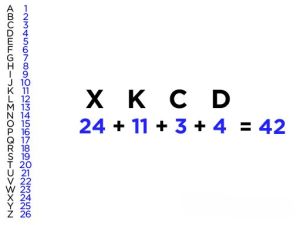
This was most likely a coincidenceIf each letter of the alphabet is mapped to 1 through 26, the sum of the values for "x", "k", "c", and "d" is equal to 42, which is the answer given to the Ultimate Question of Life, The Universe, and Everything by the supercomputer in The Hitchhiker's Guide to the Galaxy. However, based on the quotes by Randall reported above, it does not seem this was intentional.
A now-deleted Reddit account noted that typing "xkcd" on a Persian QWERTY keyboard returns "طنزی", which means satirical, sarcastic, and comic.
"x", "k", "c", and "d" are consecutive letters when typed on a left-handed Dvorak keyboard.
By shifting the letters in "xkcd" one key up on a standard QWERTY keyboard, you end up with the word "side".
A Quora user noted that reversing the letters in "xkcd" gives "dckx", which can be pronounced as "dicks".
I was going through old math/sketching graph paper notebooks and didn't want to lose some of the work in them, so I started scanning pages. I took the more comic-y ones and put them up on a server I was testing out, and got a bunch of readers when BoingBoing linked to me. I started drawing more seriously, gained a lot more readers, started selling t-shirts on the site, and am currently shipping t-shirts and drawing this comic full-time. It's immensely fun and I really appreciate y'all's support.
Before Randall started using the xkcd.com website for his comics, he posted them on LiveJournal using the "xkcd_drawings" account. The images on the page are now broken, but there are archived versions for the first 16 comics, comics from 17 to 27, and the last 20 comics. Randall didn't add a title text to his comics before xkcd.com, but most of the comics posted on LiveJournal had an original caption beneath the image, and many had comments by LiveJournal users. All the comics transferred to the new site had a title text, which was often along the same lines, but was almost never the same as the caption on LiveJournal.
The original title, caption, and release number of these early comics can be viewed on their explanation page, so if you want to browse them in the original order, you can start here and follow the links at the top of each explanation to go to the next one. To view a list of all the comics in the original order, see Posted on LiveJournal.
Starting from the following post, he began following the normal Monday, Wednesday, Friday release date routine, although he sometimes forgot to post the comic in time, making them come out a day earlier or a day later. See Comics by weekday for more information. Some of these comics were drawn on checkered paper, but the practice stopped once he started posting regularly on xkcd.com. The only comics drawn on checkered paper first published after the new xkcd website opened were the three exclusive comics mentioned below (12: Poisson, 5: Blown apart, and 36: Scientists).
The last comic to be released before xkcd.com was in use was 39: Bowl. It was the 41st comic posted on LiveJournal on December 5, 2005, but the following day Randall made another post, titled "Announcement":
What with winter break starting and the like, I'll probably be going off my regular update schedule. I'll try to post something here and there, and might end up doing more drawings than I expect, but won't stick to the MWF schedule. Thanks for the support! This has been and will continue to be a lot of fun.
This may be due to his exams coming up, or the preparation for the release of xkcd.com the following year. The next LiveJournal comic, 45: Schrodinger, was released almost a month later, on January 4, 2006, after Randall had already posted all the previous comics to his new site.
The new xkcd website opened on January 1, 2006, and the backlog of 41 comics from LiveJournal from 1: Barrel - Part 1 to 44: Love was transferred on the same day, but in a completely different order. The only comic that has the same number on both sites is 3: Island (sketch), while all the other comics were uploaded seemingly at random. Also, only eleven of the original comic titles were reused on the new site, and even among the last eleven comics posted on both sites, only six used the same title.
There were also two new comics released on the first day of xkcd.com and a third new comic inserted a few months later. These three comics were the last comics to be drawn on checkered paper. 12: Poisson and 5: Blown apart were exclusively published on the first day of xkcd.com and were never posted on LiveJournal. 36: Scientists was instead initially published as a duplicate of comic 10: Pi Equals. According to an email exchange between Randall Munroe and an editor from explain xkcd, he later corrected this duplication on April 28, 2006, almost four months after the site's launch. Prior to this confirmation, readers had only been able to narrow the replacement window to between April 23, 2006 and July 5, 2006, based on Web Archive captures. The comic's art style and content suggested it may have been an older, unused drawing selected to better match the tone and aesthetic of the surrounding comics.
In February 2025, User:FaviFake, an editor from this wiki, contacted Randall Munroe via email to clarify the exact date that 36: Scientists was swapped in. Munroe responded the same day, resolving a long-standing ambiguity surrounding the comic's release date and allowing explain xkcd to assign an official release date to 36: Scientists:
[...] I had totally forgotten about this! Checking my logs, I believe I swapped it in on April 28th. [...]
Most of the eleven comics posted both on LiveJournal and on xkcd.com after the new website opened, from 45: Schrodinger to 55: Useless, were posted on the same day on both sites. For unknown reasons, on January 18, 2006, 54: Science was posted on LiveJournal on the same day that 51: Malaria was released on xkcd.com. Three days later, on January 21, 2006, 51: Malaria was posted on LiveJournal, thus forcing the next two comics (52: Secret Worlds and 53: Hobby) to be released on xkcd.com two days before LiveJournal. Four days later, on January 25, 2006, 54: Science was finally posted on xkcd.com, which fixed the date discrepancies and allowed the next comic, 55: Useless, to be published on the same day across both sites.
Hey: I'm closing down this journal. Friend the new feed. Thanks to new revisions to my site and work by Derek, I now have automated posting -- if I go missing for a few weeks, as long as I've got enough comics in the queue no one will notice. The site also now has the more traditional 'forward' and 'back' format to make browsing easier. Most importantly, the site now has an RSS feed which is updated automatically whenever a drawing is posted. This means I no longer need to separately update this journal, so I'm closing it down and you should all friend the feed: xkcd_rss Thanks! Exciting times ahead, etc.
Almost two months later, he published his last post on the LiveJournal account on April 23, 2006. It warned that the old account had been inactive for a long time and recommended everyone friend the new RSS feed, called "xkcd_rss", which is still in use today. Despite saying the old account would be "deleted soon", it still exists. The post was titled "Unfriend this journal":
This journal has been closed for a while, and I'm going to delete it shortly. If you want to see my comic -- which is updated like clockwork every MWF, thanks to some wonderful automation by davean -- you should add xkcd.com's LJ RSS feed instead. This journal will be deleted soon.