Difference between revisions of "3178: Hyperacute Interdynamics"
(→Explanation) |
(→Explanation) |
||
| (12 intermediate revisions by 6 users not shown) | |||
| Line 11: | Line 11: | ||
==Explanation== | ==Explanation== | ||
{{incomplete|This page was created BY A STAR WITH THE MASS OF A SQUIRREL. Don't remove this notice too soon.}} | {{incomplete|This page was created BY A STAR WITH THE MASS OF A SQUIRREL. Don't remove this notice too soon.}} | ||
| − | [[Miss Lenhart]] is teaching a class, a recurring theme on [[xkcd]]. She correctly describes two of the three pillars of physics: {{w|general relativity}}, concerning very large objects, and {{w|quantum mechanics}}, concerning very small objects. The third pillar is {{w|thermodynamics}}, but she replaces this with the fictional ''hyperacute interdynamics'', which supposedly specifically covers objects 10 | + | [[Miss Lenhart]] is teaching a class, a recurring theme on [[xkcd]]. She correctly describes two of the three pillars of physics: {{w|general relativity}}, concerning very large objects, and {{w|quantum mechanics}}, concerning very small objects. The third pillar is {{w|thermodynamics}}, but she replaces this with the fictional ''hyperacute interdynamics'', which supposedly specifically covers objects 10 – 30 cm (~4" – ~12") in size and 200 – 700 g (0.44 lb – 1.54 lb) in mass. |
| − | When a student points out that the application of hyperacute interdynamics is quite limited, Miss Lenhart responds by stating that this is made up for by the fact that it is apparently very accurate and precise, and | + | When a student points out that the application of hyperacute interdynamics is quite limited, Miss Lenhart responds by stating that this is made up for by the fact that it is apparently very accurate and precise, and states that it is able to perfectly describe {{w|squirrel}}s and {{w|grapefruit}}, two objects which fit the necessary size and weight specifications (though see below). Her comment that there are hopes to unify this system with the other two reflects the efforts of physicists to {{w|Quantum gravity|unify}} general relativity with quantum mechanics, so far without success. |
| − | + | While there is no actual field called hyperacute interdynamics, there is one of {{w|mesoscopic physics}}, described as the study of materials of an "intermediate size". The upper end of mesoscopic physics studies objects whose length is measured in micrometers — much smaller and lighter than what hyperacute interdynamics would study, so the analogy is not perfect. On the other hand, it happens fairly frequently in science that two separate length scales may be studied by different fields with no overlap. In this situation, innovations are, in principle, possible by trying to fill in this gap. An example is that structural biology is concerned with proteins and protein-sized objects, while cell biology is concerned with organelles; experimental techniques for studying phenomena between these two scales were less well-established until the development, in the 2010s, of cryo-electron microscopy. | |
| − | The | + | The title text extends the riff on unification, noting that, under the current system, measurements which require elements from all three pillars are impossible. The example given — when a nanometer-sized squirrel (suggesting an understanding of equivalence across both quantum mechanics and hyperacute interdynamics) eats a grapefruit with the mass of the Sun (similarly, general relativity meshing with hyperacute interdynamics) — would cover all three domains. Such objects are not known to occur in real life, so it is unknown how or why scientists would be trying to measure them. A black hole with the mass of the Sun would have a Schwarzschild radius of 2.95 km, so it would take some significant revisions to theory to accommodate a grapefruit-sized object with that mass, before even considering how a squirrel of that small size (but of more normal mass) could exist ''and'' eat the former object. |
| − | Individually, the head-and-body size and the tail size of the eastern gray squirrel are each within the hyperacute effective size (though potentially not mass). If they were modelled individually, or if the squirrel curled up, then | + | The {{w|eastern gray squirrel}}, which is the most prevalent squirrel in Massachusetts (where [[Randall]] lives), measures 16-20 inches (approx. 40-50 centimeters) on average when fully grown — outside the range of sizes given for hyperacute interdynamics to apply. It does, however, weigh between 400 and 600 grams — within the weight range. Whether hyperacute interdynamics would apply, then, would appear to depend on whether the 'and' in Miss Lenhart's statement is inclusive (a {{w|Union (set theory)|union}} of candidates from the two separately applicable ranges) or exclusive (only items within the {{w|Intersection (set theory)|intersection}} of both stipulations), though the title text suggests that the former is the more logical. |
| + | |||
| + | Individually, the head-and-body size and the tail size of the eastern gray squirrel are each within the hyperacute effective size (though potentially not mass). If they were modelled individually, or if the squirrel curled up, then they may become able to be effectively modelled by hyperacute interdynamics, even if the entire, stretched out squirrel cannot. This shows the absurdity of hyperacute physics, with such a strict cut-off making it easy for objects to enter and exit the hyperacute effective size. By contrast, relativity and quantum mechanics slowly become worse at describing reality as size increases/decreases. | ||
Some squirrels, such as the {{w|Borneo black-banded squirrel}} do entirely fit into the hyperacute effective size and mass. | Some squirrels, such as the {{w|Borneo black-banded squirrel}} do entirely fit into the hyperacute effective size and mass. | ||
| Line 44: | Line 46: | ||
[[Category:Comics featuring Jill]] <!--Cueball is not a child, this is a school with children so the child is not Cueball--> | [[Category:Comics featuring Jill]] <!--Cueball is not a child, this is a school with children so the child is not Cueball--> | ||
[[Category:Physics]] | [[Category:Physics]] | ||
| − | [[Category: | + | [[Category:Squirrels]] |
[[Category:Food]] | [[Category:Food]] | ||
Latest revision as of 19:16, 9 December 2025
| Hyperacute Interdynamics |
 Title text: Our models fall apart where the three theories overlap; we're unable to predict what happens when a nanometer-sized squirrel eats a grapefruit with the mass of the sun. |
Explanation[edit]

|
This is one of 51 incomplete explanations: This page was created BY A STAR WITH THE MASS OF A SQUIRREL. Don't remove this notice too soon. If you can fix this issue, edit the page! |
Miss Lenhart is teaching a class, a recurring theme on xkcd. She correctly describes two of the three pillars of physics: general relativity, concerning very large objects, and quantum mechanics, concerning very small objects. The third pillar is thermodynamics, but she replaces this with the fictional hyperacute interdynamics, which supposedly specifically covers objects 10 – 30 cm (~4" – ~12") in size and 200 – 700 g (0.44 lb – 1.54 lb) in mass.
When a student points out that the application of hyperacute interdynamics is quite limited, Miss Lenhart responds by stating that this is made up for by the fact that it is apparently very accurate and precise, and states that it is able to perfectly describe squirrels and grapefruit, two objects which fit the necessary size and weight specifications (though see below). Her comment that there are hopes to unify this system with the other two reflects the efforts of physicists to unify general relativity with quantum mechanics, so far without success.
While there is no actual field called hyperacute interdynamics, there is one of mesoscopic physics, described as the study of materials of an "intermediate size". The upper end of mesoscopic physics studies objects whose length is measured in micrometers — much smaller and lighter than what hyperacute interdynamics would study, so the analogy is not perfect. On the other hand, it happens fairly frequently in science that two separate length scales may be studied by different fields with no overlap. In this situation, innovations are, in principle, possible by trying to fill in this gap. An example is that structural biology is concerned with proteins and protein-sized objects, while cell biology is concerned with organelles; experimental techniques for studying phenomena between these two scales were less well-established until the development, in the 2010s, of cryo-electron microscopy.
The title text extends the riff on unification, noting that, under the current system, measurements which require elements from all three pillars are impossible. The example given — when a nanometer-sized squirrel (suggesting an understanding of equivalence across both quantum mechanics and hyperacute interdynamics) eats a grapefruit with the mass of the Sun (similarly, general relativity meshing with hyperacute interdynamics) — would cover all three domains. Such objects are not known to occur in real life, so it is unknown how or why scientists would be trying to measure them. A black hole with the mass of the Sun would have a Schwarzschild radius of 2.95 km, so it would take some significant revisions to theory to accommodate a grapefruit-sized object with that mass, before even considering how a squirrel of that small size (but of more normal mass) could exist and eat the former object.
The eastern gray squirrel, which is the most prevalent squirrel in Massachusetts (where Randall lives), measures 16-20 inches (approx. 40-50 centimeters) on average when fully grown — outside the range of sizes given for hyperacute interdynamics to apply. It does, however, weigh between 400 and 600 grams — within the weight range. Whether hyperacute interdynamics would apply, then, would appear to depend on whether the 'and' in Miss Lenhart's statement is inclusive (a union of candidates from the two separately applicable ranges) or exclusive (only items within the intersection of both stipulations), though the title text suggests that the former is the more logical.
Individually, the head-and-body size and the tail size of the eastern gray squirrel are each within the hyperacute effective size (though potentially not mass). If they were modelled individually, or if the squirrel curled up, then they may become able to be effectively modelled by hyperacute interdynamics, even if the entire, stretched out squirrel cannot. This shows the absurdity of hyperacute physics, with such a strict cut-off making it easy for objects to enter and exit the hyperacute effective size. By contrast, relativity and quantum mechanics slowly become worse at describing reality as size increases/decreases.
Some squirrels, such as the Borneo black-banded squirrel do entirely fit into the hyperacute effective size and mass.
Transcript[edit]
- [Miss Lenhart is teaching a classroom holding a finger up in front of the class. Two students can be seen sitting at desks in front of her, a Cueball like boy is on the first row and Jill, taking notes, is in the second row.]
- Miss Lenhart: Modern physics rests on three main pillars:
- General relativity, which describes very massive objects,
- [Close up of Miss Lenhart.]
- Miss Lenhart: Quantum Mechanics, which describes very small objects,
- [In a frame-less panel the view zooms back out, but shows only Miss Lenhart.]
- Miss Lenhart: and Hyperacute Interdynamics, which describes objects 10-30cm in size and 200-700g in mass.
- [The panel zooms back in to a close up of Miss Lenhart.]
- Student (off-panel): That last one seems kind of limited.
- Miss Lenhart: Yeah, but over it's domain it's really precise. Absolutely nails squirrels and grapefruit.
- Miss Lenhart: Someday we hope to unify it with the other two.
 Add comment
  Create topic (use sparingly)
  Refresh
 Discussion
Explanatings!!! --DollarStoreBa'alConverse 02:37, 9 December 2025 (UTC)
- E X P L A N A T E ! E X P L A N A T E ! E X P L A N A T E ! --DollarStoreBa'alConverse 02:42, 9 December 2025 (UTC)
- Incomprehension is futile - you will be explanated. 82.13.184.33 09:43, 9 December 2025 (UTC)
A black hole with the mass of the sun would have a Schwarzschild radius of 2.95 km. So it would take some significant revisions to theory to accommodate a grapefruit-sized object with that mass. Perhaps if it's digested by a squirrel, it gets smaller? BunsenH (talk) 03:32, 9 December 2025 (UTC)
- hopefully quite a bit smaller, given the size of the squirrel in this example. KelOfTheStars! (talk) 05:15, 9 December 2025 (UTC)
- Not terribly impressed with the science chops of these "unifiers" if they can't work out what's gonna happen here. Hint: it's no happy dance for the squirrel. 2605:59C8:160:DB08:CDB6:FE7F:1FC9:524 16:28, 9 December 2025 (UTC)
Eastern Gray Squirrel.... measures 16-20 inches (approx. 40-50 centimeters) .... would be too big for Hyperacute Interdynamics (10-30cm (~4"-12")) to apply. Clearly a squirrel's tail can be neglected (see: spherical cow theory), being a very skinny (even rat-like) whip with bulky but insignificant fritz. The head and body length is from 23 to 30 cm (9.1 to 11.8 in) -- Wikipedia ---- Also, a bit north of Randall's place, we have lots of "Red Squirrels" which are significantly smaller than East Gray tree-rats. "Red squirrels are much smaller than greys and measure about 35centimetres including their tails and grow to around 350grams." - (YouTube) Our locals say "chipmunk" but I knew chipmunks from Sequoya Nat Park and these aint them. --PRR (talk) 06:45, 9 December 2025 (UTC)
- I'm from Randall's area and we always called chipmunks chipmunks. Yes, we heard of red squirrels, but only saw gray squirrels and chipmunks. Massachusetts has a population with steadfast opinions. Doubt it? Try driving in Boston. 173.188.192.138 14:09, 9 December 2025 (UTC)
- Lots of red squirrels in SE Mass ("South Shore"). They don't like cities much. Very intelligent animals. 2605:59C8:160:DB08:CDB6:FE7F:1FC9:524 16:15, 9 December 2025 (UTC)
- Would the tail be excluded? Yes it's an extension, but it's certainly a part of the squirrel, and as such would contribute to it's length. --DollarStoreBa'alConverse 14:36, 9 December 2025 (UTC)
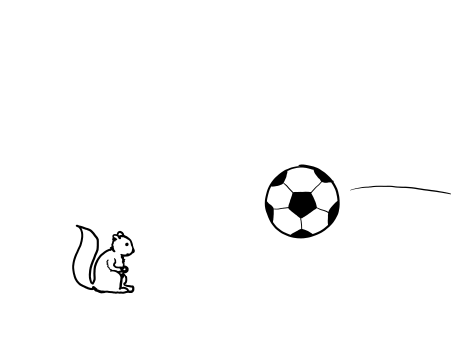
- I don't think there's a prblem. When the squirrel is sat passively, it fits (roughly) within the size constraints and is therefore fully explainable via Hyperacute Interdynamics. Once it starts running around and jumping, with its tail trailing behind it, the predictive ability of theory lessens (needn't be a cliff-edge of understanding, could even smoothly sustain near-perfect accuracy for the Black giant squirrel, at least at rest, just isn't so fundemnentally precise any more) but HI is entirely accurate again the moment it stops to nibble a nut.
- Though do squirrels eat grapefruit? (Solar-massive ones or otherwise.) I know someone left out pumpkin flesh, on a fallen tree in a woods near me, clearly from having created a Jack-O-Lantern for this year's Halloween (and apparently not thought to try making a few batches of pumpkin soup, for whatever reason), and it sat there for weeks (until it disintigrated) with no sign of either squirrels (American greys, unfortunately) or birds partaking of the 'feast'. 82.132.236.87 17:55, 9 December 2025 (UTC)
- Every year during Jack-o-Lantern season, squirrels are constantly trying to eat them even before they start rotting. I believe they're, once again, American Grays. They do indeed partake in feasts here, at least. --DollarStoreBa'alConverse 18:47, 9 December 2025 (UTC)
- Assuming, like me, that IP is in the UK... perhaps our 'invasive' Greys (hence the 'unfortunately'?) just haven't yet got used to the proliferation of pumpkins (we always used to make do with turnips, round here, until comparatively recent absorption of the US-style traditions). And the native reds are now far less likely to be near significant population so probably don't partake very much on such human bounty. 78.144.255.82 19:43, 9 December 2025 (UTC)
- Every year during Jack-o-Lantern season, squirrels are constantly trying to eat them even before they start rotting. I believe they're, once again, American Grays. They do indeed partake in feasts here, at least. --DollarStoreBa'alConverse 18:47, 9 December 2025 (UTC)
- Would the tail be excluded? Yes it's an extension, but it's certainly a part of the squirrel, and as such would contribute to it's length. --DollarStoreBa'alConverse 14:36, 9 December 2025 (UTC)

Should we think of a name for this young cueball? He's been around quite a lot but still anonymous.--Darth Vader (talk) 21:13, 9 December 2025 (UTC)
Where does the "three pillars" of physics in the current explanation come from? I thought it was just Relativity and Quantum mechanics? Isn't thermodynamics explained by Quantum mechanics? (IMO it also makes the joke funnier if there isn't a third pillar being deleted by hyperacute interdynamics, but a third pillar made up full cloth). (Wowitschris (talk) 21:58, 9 December 2025 (UTC))
I thought the third pillar would be classical physics? There doesn't seem to be an official or consensus definition of the pillars of physics (that I can find by googling), so the third may forever remain a mystery. Unless it was Hyperacute Interdynamics all along. 70.110.132.22 01:52, 10 December 2025 (UTC) Add comment

